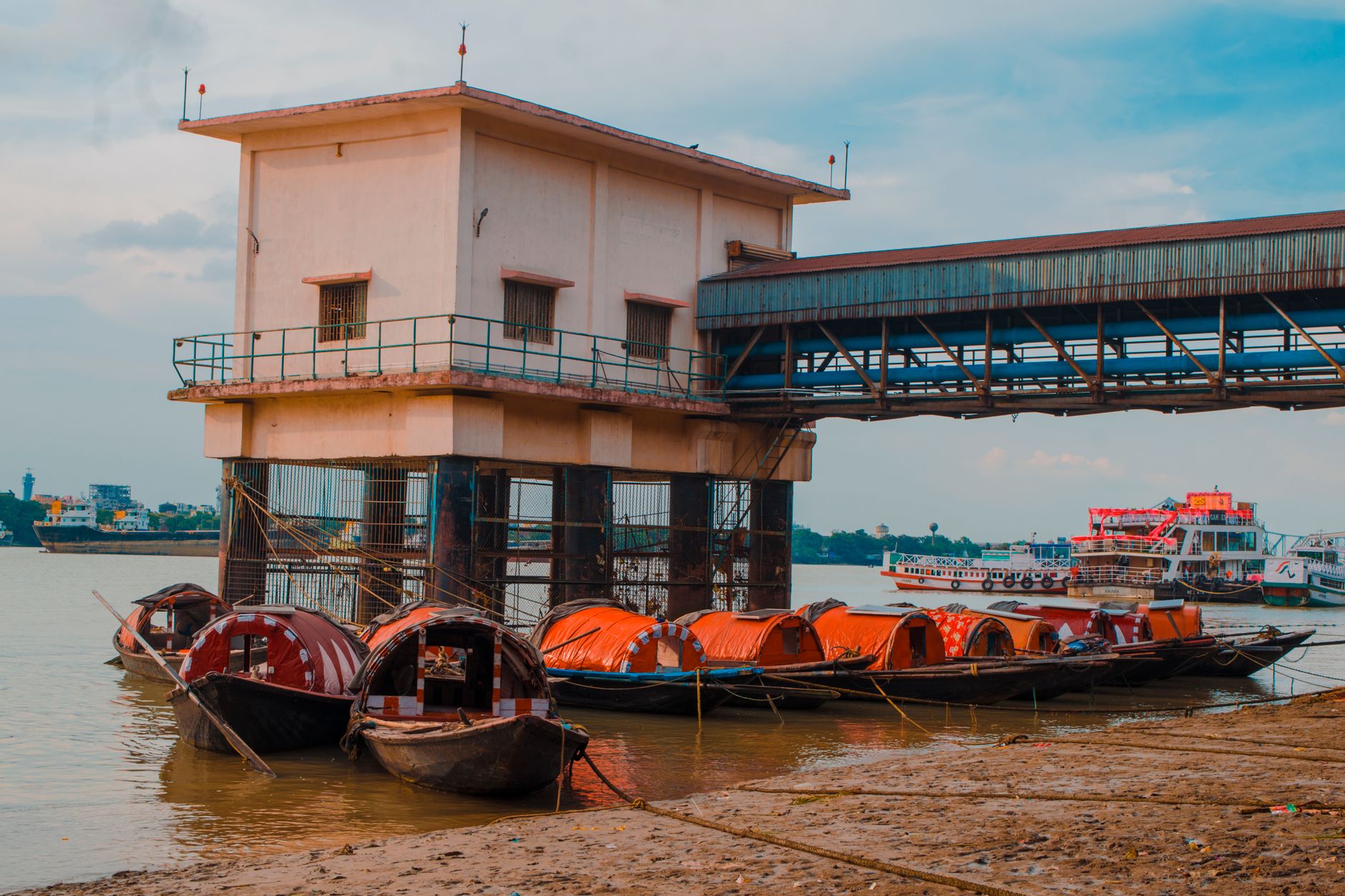
The Hooghly's boatyards are not a formal attraction with a ticket counter. They sit mostly on the Howrah bank, in the strip between Howrah Station and the riverside ghats at Shibpur and Bichali, where families have been shaping sal and teak hulls for generations. You will see ribs propped on bamboo scaffolding, cauldrons of tar and stacks of seasoned planks. A morning visit between October and February is most comfortable; the yards work from roughly 7am. Be quiet, ask before photographing and never walk under a hull being turned.
Where the wooden boats are still built
The Hooghly's boatyards are not a formal attraction with a ticket counter. They sit mostly on the Howrah bank, in the strip between Howrah Station and the riverside ghats at Shibpur and Bichali, where families have been shaping sal and teak hulls for generations. You will see ribs propped on bamboo scaffolding, cauldrons of tar and stacks of seasoned planks. A morning visit between October and February is most comfortable; the yards work from roughly 7am. Be quiet, ask before photographing and never walk under a hull being turned.
The easiest approach is the ferry from Fairlie Place or Armenians Ghat to the Howrah side, then a short auto-rickshaw ride along the Grand Trunk Road stretch. Distances are small but traffic is not: allow 30-40 minutes from BBD Bagh, more after 5pm. No yard charges an entry fee, and there is nothing to buy except the odd hand-carved model. Treat this as a working neighbourhood, not a heritage park, and keep groups small.
Kumartuli, where the craft year turns
North of the city centre, between Rabindra Sarani and the river at Sovabazar, Kumartuli's lane workshops supply most of Bengal's Durga and Kali idols. The cycle matters for timing. From around June the straw-and-clay armatures go up; through September the painting and dressing dominate; by October the lanes empty as images leave for pandals. Visit in August or early September and you will see the whole process. In the weeks before Durga Puja, space is tight and artisans are working flat out.
Reach it via Sovabazar Sutanuti metro station, a five-minute walk. Photography is usually welcome, but ask first and expect to leave a small contribution in the potters' collection box, not a fixed fee. Skip the touts who offer guided entry near the main lane; the workshops are freely visible from the street. Combine it with a walk down to Ahiritola Ghat, where the ferries cross, and a look at the fading riverfront houses on the way.
Jute, brass and the riverside trades
The Hooghly's craft economy was never only boats. The jute mills of Howrah and the mill belt at Budge Budge, downstream towards the Sundarbans, once made this one of the busiest industrial rivers in Asia. Most mills are closed, but the warehouse architecture survives along the Strand and in Howrah's older lanes, and the river still carries sand barges and dredgers past the ghats. A slow walk from Prinsep Ghat to Babughat at dusk shows that traffic better than any museum.
For something you can actually take home, head to the brass and bell-metal workshops around Bhowanipore and the older parts of north Kolkata, where karais and ghungroo sets are still hammered by hand. Prices vary widely and bargaining is normal; there is no fixed rate card, so ask other shops before committing. If you want a single day combining river and craft, I would book a hotel near Esplanade or Sudder Street: you can reach Fairlie Place, Sovabazar and Prinsep Ghat easily, and the airport is roughly an hour away outside peak hours.
Practical geography for a craft-focused stay
Central Kolkata is the sensible base for this itinerary. From Esplanade, the Fairlie Place ferry ghat is a ten-minute walk and the Sovabazar metro is two stops north. Hotels around Sudder Street and Park Street suit most budgets; the New Market area gives you the widest spread of rooms and the shortest walk to the river. Salt Lake and Rajarhat are cheaper per night but add 30-45 minutes each way, which eats the morning light you want in the yards.
Weather decides the rest. November to February is dry and mild, ideal for walking Howrah's lanes and the Strand. March to May is hot and humid; start by 6.30am and finish before eleven. The monsoon from June to September floods the ghats and closes some yards, though it is the best season for Kumartuli's clay work. Whatever the month, carry water, wear closed shoes for the yards, and skip the packaged river cruises if you want to see actual building rather than a shoreline commentary.
Related articles
FAQ
How do I get to the Hooghly boatyards from central Kolkata?
Take the ferry from Fairlie Place or Armenians Ghat to Howrah, then a short auto-rickshaw towards Shibpur. By road it is 30-40 minutes from BBD Bagh. Ferries run frequently during daylight hours.
When is the best time to see Kumartuli's idol makers at work?
Late August to early September shows the full process of clay modelling and painting. Before Durga Puja in October the lanes are at their busiest; from November to May there is much less to see.
Is there an entry fee for the boatyards or Kumartuli workshops?
No fixed entry fee. Workshops are working premises visible from the street. If you photograph, ask permission and offer a small contribution rather than treating it as a ticketed attraction.
How long should I allow for a river-and-craft day?
Plan a full morning and early afternoon: two hours in Howrah, an hour's ferry and walk, then two to three hours around Kumartuli and Ahiritola Ghat. Allow extra for traffic after 5pm.
Where should I stay for this itinerary?
Esplanade, Sudder Street and New Market put you within walking distance of Fairlie Place and the metro at Sovabazar. Salt Lake and Rajarhat add 30-45 minutes of daily travel.
Can I buy wooden model boats or brassware directly from the makers?
Yes, small model boats are sometimes sold at the Howrah yards, and brass utensils are still made in Bhowanipore workshops. Bargaining is expected; check prices in several shops first. Carry cash.
What should I wear and bring for visiting the yards?
Closed shoes, light cotton clothing and water. The yards have splinters, tar and uneven ground. Carry a hat between March and May, and an umbrella during the monsoon months.
Is the area accessible for travellers with limited mobility?
Not especially. The yards, ghats and Kumartuli lanes have uneven surfaces and steps, and ferries require careful boarding. A car-based route along the Strand gives river views with far less walking.
Read next
- Best time to visit Kolkata: a month-by-month guide
- Where to stay in Kolkata
- Things to do in Kolkata
- More from the Kolkata blog
Sources: West Bengal Tourism, Metro Railway Kolkata, India Meteorological Department.
Editorial review: 18 November 2026. Opening days, fares and festival dates change; check before you go.