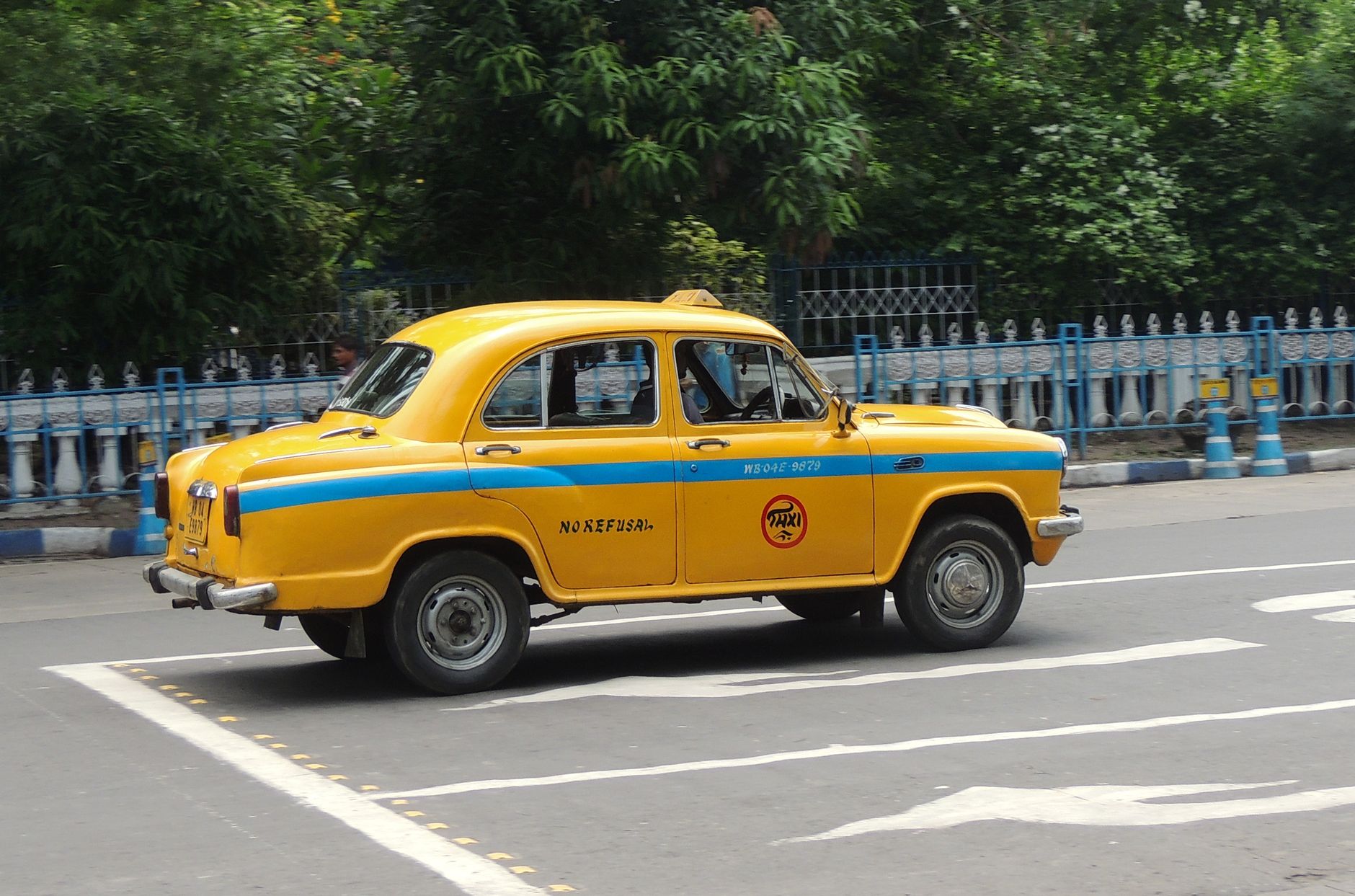
Yellow Ambassador taxis are metered and still plentiful, though the fleet shrinks each year because the Ambassador stopped production in 2014. Insist on the meter, expect occasional refusals at shift change, and keep app-based cabs as a backup. For river crossings a ferry beats both, and the metro beats everything on the north-south corridor.
What is a yellow taxi in Kolkata?
The yellow taxi is a Hindustan Ambassador in the city's taxi livery, with a meter on the dashboard and a printed fare chart the driver is expected to carry. The Ambassador went out of production in 2014, so the fleet shrinks each year and other cars have joined the trade. Even so, a yellow Ambassador is still the easiest hail on most central streets, and the drivers know the older lanes better than any app.
Taxis wait at stands outside railway stations, large hotels, markets and office districts, and they cruise for fares on the main roads. From the pavement you raise a hand, the driver pulls over, and you state the destination before getting in. Some drivers quote a flat sum instead of running the meter. The meter is the correct basis for the fare, and the printed chart settles most arguments. Ask before the car moves, not after.
How do meters and fare charts work?
A Kolkata taxi meter is a unit on the dashboard, mechanical in the older Ambassadors and electronic in newer cars. The driver flags it down at the start of the trip and the reading climbs with distance and waiting time. Drivers should carry a printed fare chart that turns meter readings into the current rate. Rates are revised from time to time by the state transport authority, so check the current fare rather than trusting an old figure.
If a driver declines the meter and asks for a lump sum, you can refuse and find another cab, or agree a figure before the wheels move. Note the registration number and the time, and take a complaint to the traffic police or the transport department rather than arguing at the roadside. Keep small notes and coins for the exact fare, because change is often short early in the morning and late at night.
Why do taxi drivers refuse a trip?
Refusals are common and usually practical rather than personal. A driver may be finishing a shift, heading home to a distant suburb, or unwilling to sit in a jam on a one-way stretch. Short hops in heavy traffic earn little and take a long time. Rain, a big festival or a cricket match at Eden Gardens makes a refusal more likely, so allow extra time or book an app-based cab instead.
The practical approach is to ask before sitting down, state the destination clearly, and keep a second option in mind. Outside Howrah and Sealdah stations the queue moves quickly because the prepaid counter assigns the driver. Around Park Street and New Market a cab usually appears within a few minutes in daylight. When cars change drivers the wait lengthens, and a walk to a bigger stand helps.
- Shift change: Cars changing drivers are often going off duty, so a refusal at that hour is routine.
- Short hops: A brief ride in crawling traffic earns little, so a longer fare is more welcome.
- One-way streets: Central Kolkata has many, and a driver may decline rather than loop back through them.
- Weather: During a downpour or a festival crowd, demand outruns supply and refusals rise.
How do app-based cabs work?
App-based cabs work through a smartphone app. You set the pickup point, the app matches a driver, and the fare is calculated and shown before you confirm. Payment can be by card, UPI or cash. The cars are usually ordinary hatchbacks and sedans rather than Ambassadors, and the driver often calls before arriving when the pickup point is hard to find. The app records the trip, which helps if something goes wrong.
Pickup is where the system creaks. Kolkata's lanes and one-way systems mean the map pin often lands somewhere awkward, and drivers ask you to walk out to a main road. Waiting charges start after a few minutes. In rain, at rush hour or during a big festival, availability drops and the app may quote a higher fare; accepting it is a choice rather than a rule.
Taxis at the airport and stations
Netaji Subhas Chandra Bose International Airport has prepaid taxi counters inside the arrivals hall. You pay at the counter, take the slip and hand it to the driver at the rank outside, which removes the bargaining step. App-based cabs use a designated pickup zone a short walk from the terminal. The Yellow Line metro station, Jai Hind Bimanbandar, serves the airport; check Metro Railway Kolkata for current services and hours.
At Howrah and Sealdah the taxi rank sits outside the main exit, and prepaid desks operate at busy hours. Road times vary: the airport to Park Street is roughly 45 to 75 minutes depending on traffic, while Salt Lake and New Town are 20 to 40 minutes. Leave a generous buffer before a flight, and check the reporting time for your flight before setting out.
- Prepaid counter: Pay inside the terminal and travel on the slip, which avoids any argument about the fare.
- Metro option: The Yellow Line stops at Jai Hind Bimanbandar; check Metro Railway Kolkata before relying on it.
- Station ranks: Howrah and Sealdah both have taxi ranks outside the main exit and prepaid desks at busy hours.
- Buffer time: The airport road is unpredictable, so leave a margin before a flight rather than cutting it fine.
What about autos and hand-pulled rickshaws?
Auto-rickshaws run on fixed shared routes rather than on a meter. You name the destination, the driver names the route, and a set amount covers the segment. They are quickest for short hops between neighbourhoods and awkward with luggage. In parts of the centre they are kept off the main roads during busy hours, so they serve side streets and suburban stretches, and the routes change as traffic rules do.
Hand-pulled rickshaws still work short distances in parts of the old city, notably around College Street, Shyambazar and the lanes off BBD Bagh. There is no meter, so agree the amount before the rickshaw moves. They suit a few hundred metres with light luggage, and they are slow. Trams survive on a handful of routes, and buses cover the rest of the city, crowded at peak times.
When is the metro or a ferry quicker?
The metro is almost always faster than a cab on the north-south axis. The Blue Line runs from Dakshineswar through Shyambazar, Esplanade, Park Street, Kalighat and Rabindra Sarobar to Kavi Subhash, under the worst of the traffic. The Green Line crosses beneath the Hooghly from Howrah Maidan to Esplanade, then on through Sealdah to Salt Lake Sector V. Check Metro Railway Kolkata for current stations and hours.
Ferries are the quickest way across the Hooghly. Services link Howrah, Babughat, Shobhabazar, Bagbazar, Dakshineswar and Belur, and a crossing takes a fraction of the time a bridge journey costs in traffic. On the road, Howrah Bridge and Vidyasagar Setu both jam at peak hours. For Dakshineswar and Belur Math, the ferry or the train often beats a cab from the centre.
- North to south: For Shyambazar, Esplanade or Kalighat, the Blue Line beats any cab in the peak.
- Across the river: A Hooghly ferry from Babughat or Howrah is faster than either bridge in traffic.
- Dakshineswar: The temple sits on the Blue Line, and the ferry from Bagbazar is a slower, quieter alternative.
- Salt Lake: The Green Line reaches Sector V, from where autos and cabs cover New Town.
Is travel at night safe?
Kolkata keeps late hours by Indian standards, and central streets stay busy well into the evening. After midnight taxis thin out and a metered cab is harder to flag. Book an app-based cab instead, wait indoors or in a lit doorway, and match the registration plate and driver name to the app before getting in. Share the trip details with someone who is expecting you.
Metered yellow taxis are fine at night, provided the meter is running and the fare chart is to hand. Hand-pulled rickshaws are best avoided after dark on unfamiliar lanes. If something goes wrong, Kolkata Police and the traffic police are the bodies to contact, and an app-based cab keeps a trip record that helps. Travelling alone, a booked cab is usually the calmer choice than a street hail.
FAQ
Do yellow taxis in Kolkata use a meter?
Yes, metered fares are the rule and the driver should flag the meter down when the trip starts. A printed fare chart converts the reading into the current rate. If a driver quotes a flat sum instead, you can decline and take another cab. Rates change from time to time, so check the current fare with the state transport authority.
Why do yellow taxis in Kolkata refuse some trips?
Most refusals are about time and money rather than the passenger. A driver may be ending a shift, heading to a distant suburb, or unwilling to enter a one-way jam for a short fare. Rain and big events make refusals more likely. Asking before sitting down, and keeping an app-based cab as a backup, solves most of it.
Are app-based cabs in Kolkata cheaper than yellow taxis?
Not always. A metered yellow taxi on a normal run is often the cheaper option, because app fares can rise when demand is high. App-based cabs win on certainty: the fare is shown before you confirm, the trip is recorded, and the driver comes to a set pickup point. Compare both when the app quotes a raised fare.
How do I get a yellow taxi at Kolkata airport?
Use the prepaid counter inside the arrivals hall at Netaji Subhas Chandra Bose International Airport. You pay there, take the slip and hand it to the driver at the rank outside, which avoids any discussion about the fare. App-based cabs pick up in a separate zone. The Yellow Line metro also serves the airport; check Metro Railway Kolkata for hours.
Can I pay a Kolkata yellow taxi by card or UPI?
Assume cash. Many yellow Ambassadors carry no card machine and drivers prefer notes, so keep small denominations and coins for the exact fare. Some newer cars and most app-based cabs accept UPI or cards. If you hold only a large note, mention it at the start of the trip so the driver can arrange change.
Is the metro quicker than a taxi in Kolkata?
On the north-south corridor, yes, almost always. The Blue Line runs from Dakshineswar to Kavi Subhash through Shyambazar, Esplanade, Park Street and Kalighat, beneath the traffic. The Green Line links Howrah Maidan with Esplanade, Sealdah and Salt Lake Sector V. In peak hours the metro beats any road vehicle; check Metro Railway Kolkata for current hours.
How do auto-rickshaws in Kolkata charge?
They run on fixed shared routes instead of meters. You state the destination, the driver confirms the route, and a set amount covers that segment, usually paid at the end. They are best for short neighbourhood hops and awkward with luggage. Routes and permissions change, so ask locally which stretches autos may use.
Is it safe to take a yellow taxi in Kolkata at night?
Generally yes, with the usual care. Check that the meter runs, keep the fare chart visible and note the registration number. After midnight taxis are scarcer, so a booked app-based cab with a recorded trip is often easier. Wait in a lit place, and contact Kolkata Police if a driver behaves badly or demands an off-meter fare.
How do I complain about a Kolkata yellow taxi?
Note the registration number, the time and the place, and keep the meter reading in mind. Complaints go to the traffic police or the state transport department, not to the driver at the roadside. For app-based cabs, use the in-app support and rating. Reporting works better with a car number than with a description of the driver.
Read next
- Getting around Kolkata
- The Kolkata metro: a visitor’s guide
- Arriving at Kolkata airport
- More from the Kolkata blog
Sources: Kolkata Police, West Bengal Tourism, Metro Railway Kolkata, Airports Authority of India.
Editorial review: 3 November 2026. Opening days, fares and festival dates change; check before you go.