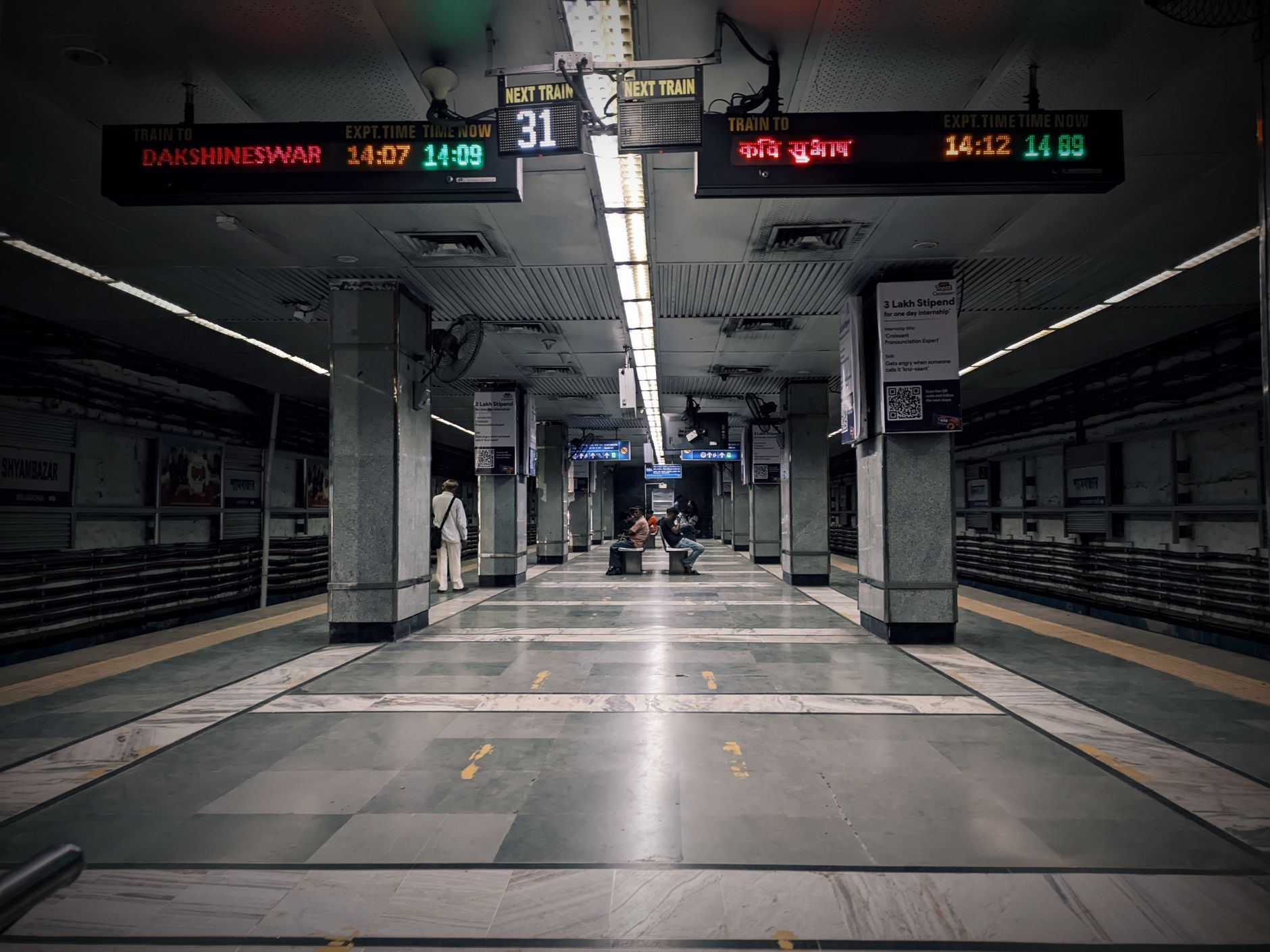
Getting around Kolkata is easiest on the metro, which beats the traffic on north-south runs and now crosses under the Hooghly on the Green Line. Yellow taxis are metered, app cabs book to a pin, and auto-rickshaws run fixed shared routes. Buses reach everywhere slowly, trams survive on a few lines, and ferries cross the river. Check Metro Railway Kolkata for current services.
How do you get around Kolkata?
Kolkata's transport is layered: a metro that beats the traffic, metered yellow taxis, app cabs, shared autos, buses, a reduced tram network and river ferries. Distances in the centre are short, but road speeds are slow, so the choice of mode matters more than the map suggests. Most north-south trips in the central belt take less time underground than on the surface. Plan each trip around one main mode rather than mixing three.
Match the mode to the errand. The metro for north-south runs and the river crossings on the Green Line; a yellow taxi or app cab for door-to-door trips with luggage; an auto-rickshaw for a short shared hop from a station; a ferry for the river and the Howrah side. Walking covers the Maidan and much of the old city, which is where the streets are most rewarding anyway. Cross the river by ferry at least once for the skyline.
Is the metro the fastest way across the city?
The metro is usually quicker than the road at any hour, and it is the one part of the network that keeps to a timetable. India's first metro opened in 1984, and the Blue Line still carries the heaviest load, running north-south through the centre via Shyambazar, Girish Park, Esplanade, Park Street, Maidan, Kalighat and Rabindra Sarobar. It is the obvious choice in the monsoon and for any timed appointment.
The Green Line runs east to west from Howrah Maidan under the Hooghly to Esplanade, Sealdah and Salt Lake Sector V. The river tunnel opened in 2024, adding a crossing that avoids the bridges entirely. Purple, Orange and Yellow lines are partly open and expanding, so check Metro Railway Kolkata for current stations and hours. Tickets come as tokens, smart cards or QR codes bought through apps, and women's seats are marked in each coach.
- Blue Line: North to south through the centre, with stops at Esplanade, Park Street, Maidan and Kalighat.
- Green Line: East to west under the Hooghly, linking Howrah Maidan with Esplanade, Sealdah and Salt Lake Sector V.
- Newer lines: Purple, Orange and Yellow are partly open and expanding; check Metro Railway Kolkata before relying on them.
- Tickets: Tokens and smart cards at stations, plus QR tickets bought through apps; women's seats are marked.
How do yellow taxis work in Kolkata?
Yellow Ambassador taxis are metered, and the meter is the point. Ask for it before the car moves and check that the flag is down; a flat figure offered instead of the meter is a negotiation, not the fare. Drivers refuse short trips and cross-river destinations most often at peak times and in rain. Hail one from a rank or the roadside. Yellow paint and a dashboard meter identify them.
Taxis earn their place for luggage, late nights and anywhere off the metro grid, including the Kalighat lanes, Tangra and the roads around New Market. They are also the fallback when app cabs show no cars nearby. Keep small notes for the fare, because drivers rarely carry change, and do not expect card machines. For a middle distance with two or three people, a metered ride is often the simplest option.
- Meter first: Ask before the car moves, and check that the flag is down.
- Refusals: Short hops and cross-river trips are refused most often at peak times and in rain.
- Where to wait: Ranks at stations, markets and big crossings beat waving at moving traffic.
- Small notes: Drivers rarely carry change, and card machines are not standard.
Are app cabs better than yellow taxis?
App-based cabs book to a pin, give an estimate before you confirm and take the haggling out of the trip. They are the easiest choice for airport runs, early trains from Howrah or Sealdah and addresses that are hard to explain. Availability tightens in heavy rain, during festivals and at the evening peak, when waits stretch and cars cancel. You see the driver's details before the car arrives.
Pickup points matter more than the app suggests. Around Park Street and the office districts, drivers often ask you to walk to a main road, and in the old city lanes a clear landmark saves a phone call. Compare the app estimate with a metered taxi before deciding. Both use the same roads, so the traffic delay is identical. Book before a fixed departure rather than at the kerb.
Where do auto-rickshaws run?
Autos in Kolkata run on fixed shared routes rather than on the meter. You join at the stand, wait for the seats to fill and get off along the way. Routes are short, often linking a metro station with a market, a hospital or a residential pocket, and the fare is settled by the route rather than by distance. Ask which route a waiting vehicle is on before you board.
They are quick and inexpensive for short hops where a taxi would sit in traffic, but they are open-sided, cramped and no use with large luggage. Availability thins after dark away from busy junctions. Outside the fixed routes autos are not for hire, so do not expect a private journey, and a request to go off-route will be refused. For door-to-door trips late at night, book a cab instead, preferably before you leave.
Do buses and trams still run in Kolkata?
Buses cover the whole city and the outer suburbs, with frequent services along the main arteries: Chittaranjan Avenue, AJC Bose Road, the EM Bypass and the approaches to Howrah and Sealdah. They are crowded at peak times and slow in traffic, but no other mode reaches as many places. Board at marked stops and keep small notes ready. Ask the conductor if you are unsure where to get off.
Trams survive on a much reduced network, with a handful of routes in the centre and the north. Check with West Bengal Transport Corporation before planning a day around one, because services change. For most visitors a tram ride is worth taking for its own sake rather than as a way to cross the city quickly. They are slow, and they show you the streets at walking pace. A conductor collects on board.
When is the traffic worst?
Weekday mornings and the late afternoon into evening are the heaviest, when offices, schools and markets overlap. Rain slows everything further: a monsoon downpour floods low stretches of road and can hold traffic for an hour or more. Build slack into any timed appointment, and take the metro where the route allows it. Two short trips with a wait between them often beat one long crawl.
Festival days change the pattern entirely. Durga Puja draws crowds to the pandals and closes some streets to traffic; check the current year's dates and follow police diversions. Christmas lights on Park Street fill the centre in the evenings from mid-December to New Year. Early morning is the quietest window for a long cross-city run, and the coolest in summer. Allow generous extra time for any fixed booking.
How do you get between the airport and the city?
Netaji Subhas Chandra Bose International Airport sits near Dum Dum, about 17 km north-east of the centre. By road, allow roughly 45 to 75 minutes to Park Street depending on traffic, and 20 to 40 minutes to Salt Lake or New Town. The airport has its own metro station, Jai Hind Bimanbandar, on the Yellow Line. Traffic on the approach road, rather than the distance, decides how long it takes.
Yellow Line services are expanding, so check Metro Railway Kolkata for current stations and hours before you rely on the metro with luggage. App cabs and prepaid taxi desks both operate from the terminals, and booking a cab before landing saves time at the kerb. Allow extra room in the evening peak and during the monsoon, when the run slows. A metered taxi from the rank is the fallback if no car is free.
What about ferries, suburban trains and walking?
Hooghly ferries link Howrah, Babughat, Shobhabazar, Bagbazar, Dakshineswar and Belur, and they give the shortest crossing to the west bank and to Belur Math. Schedules change with the season, and services can be suspended in fog. Ask at the ghat on the day. Suburban trains from Howrah and Sealdah reach the outer districts and the day-trip stations; check Indian Railways for times. Ferries are also the quietest way to see the bridges from the water.
Walking is the best way round the Maidan, the BBD Bagh heritage blocks and the lanes of North Kolkata, where hand-pulled rickshaws still work short trips in parts of the old city. Settle the destination and the fare before setting off. Comfortable shoes and an early start make the difference in summer, and a paper map helps where street signs are scarce. Cross the Maidan on foot at dusk, when the open space is at its best.
- Howrah: The busiest crossing, from the station side, with the cantilever bridge in view.
- Babughat: Central riverside ghat, close to the Maidan and Eden Gardens.
- Shobhabazar and Bagbazar: North Kolkata ghats, useful for the old city and Kumartuli.
- Dakshineswar and Belur: Crossings for the Kali temple on the east bank and Belur Math on the west.
FAQ
Do you need a car to get around Kolkata?
No. The metro, metered taxis, app cabs, shared autos, buses and ferries cover the city without a hire car. Driving yourself means unfamiliar traffic, thin parking and one-way streets. Public transport plus a taxi for luggage or late nights handles most itineraries, including trips to Dakshineswar, Belur Math and the airport.
Is the Kolkata Metro easy for visitors to use?
Yes. Stations carry English signage, and tokens, smart cards and QR tickets bought through apps cover the fare. Trains are frequent and women's seats are marked in each coach. The Blue Line covers Esplanade, Park Street, Maidan and Kalighat, while the Green Line crosses under the Hooghly to Howrah. Check Metro Railway Kolkata for current lines and hours.
How do you avoid overcharging by yellow taxis in Kolkata?
Ask for the meter before the car moves and check that it is running, because a flat figure offered at the kerb is a negotiation rather than the metered fare. Refusals are common at peak times, so have a second option ready. App cabs remove the argument entirely, since the estimate appears before you confirm.
Are app cabs reliable in Kolkata during the monsoon?
They work, but waits lengthen when it rains and cars cancel more often. Book before you need to leave rather than at the kerb, and keep a fallback: a metered taxi from a rank, or the metro, which keeps running when waterlogging slows the roads. Compare the app estimate with a taxi before deciding.
Can you hire an auto-rickshaw for a private trip in Kolkata?
No. Autos run on fixed shared routes, so you join at the stand, wait for the seats to fill and get off along the way. A request to go off-route will be refused. They suit short hops between a metro station and a market or hospital. For door-to-door trips, take a metered taxi or an app cab.
How long does the airport run take in Kolkata?
Netaji Subhas Chandra Bose International Airport is about 17 km north-east of the centre. Allow roughly 45 to 75 minutes by road to Park Street and 20 to 40 minutes to Salt Lake or New Town, with traffic on the approach road deciding the difference. The Yellow Line metro at Jai Hind Bimanbandar is an alternative; check Metro Railway Kolkata for current services.
Do Hooghly ferries in Kolkata run to a fixed timetable?
They run to a schedule, but it changes with the season and services can be suspended in fog, so ask at the ghat on the day rather than planning around a printed time. Crossings link Howrah, Babughat, Shobhabazar, Bagbazar, Dakshineswar and Belur. The rides are short and give the bridges a different angle.
Is the tram in Kolkata still worth using?
The network is much reduced, with a handful of routes in the centre and the north, so check with West Bengal Transport Corporation before planning a journey around one. A tram ride is slow and shows you the streets at walking pace, which is the reason to take it. Treat it as an experience rather than a way to cross the city.
When should you avoid crossing Kolkata by road?
Weekday mornings and the late afternoon into evening are the heaviest, and rain makes every journey slower. Durga Puja crowds and street closures disrupt the centre entirely, so check the current year's dates and follow police diversions. Early morning is the quietest window for a long cross-city run, and the coolest in summer.
Read next
Sources: Metro Railway Kolkata, Indian Railways (IRCTC), Kolkata Police, Airports Authority of India, West Bengal Tourism.
Editorial review: 3 November 2026. Opening days, fares and festival dates change; check before you go.