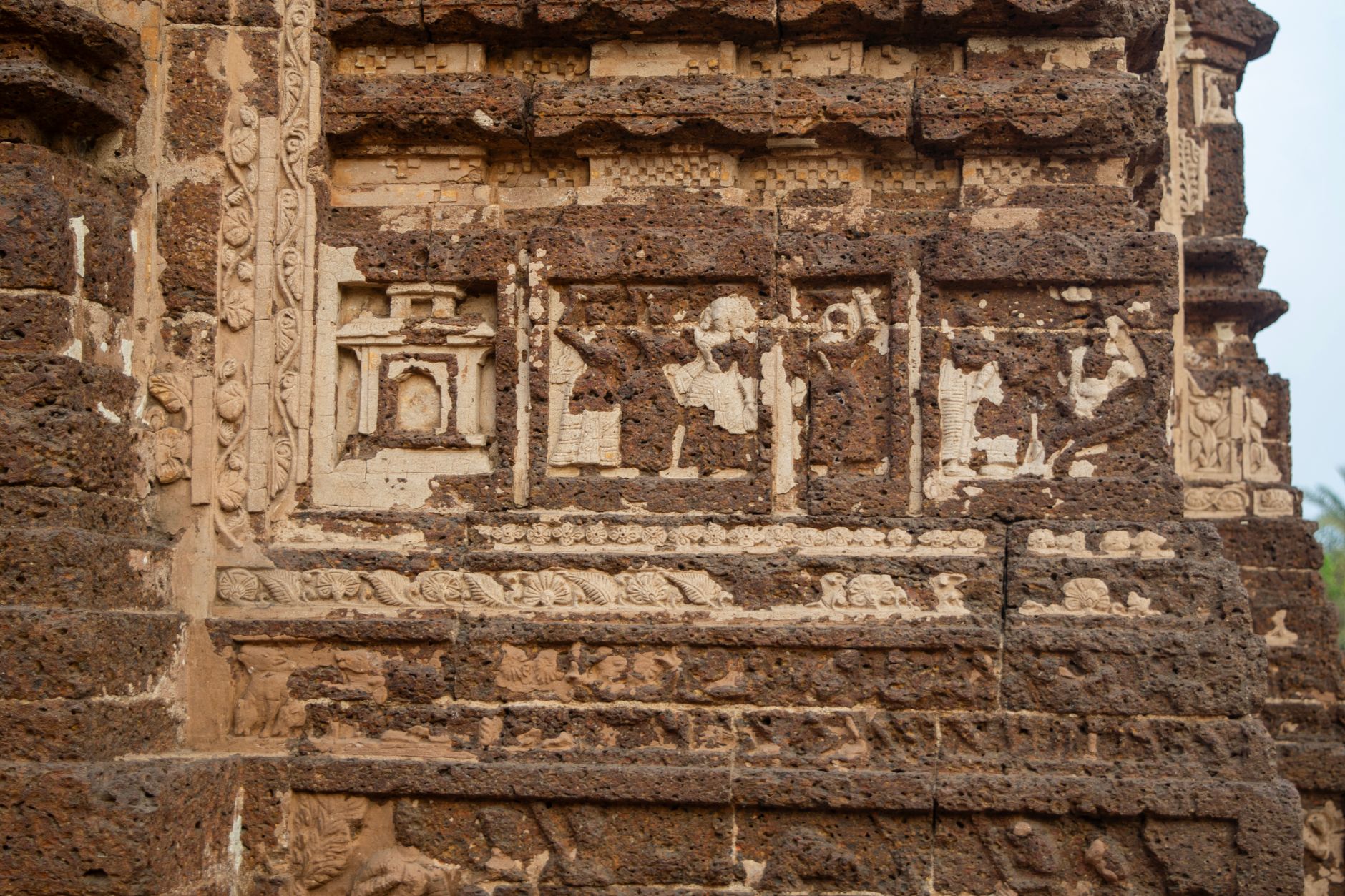
Bishnupur, in Bankura district, holds the brick and laterite temples of the Malla kings, built between about 1600 and the early eighteenth century and covered in terracotta panels. The main group, including Rasmancha, Shyam Rai, Jor Bangla and Madan Mohan, stands within walking distance in the old town. The journey from Kolkata takes roughly four hours by train or road, and one night is the sensible stay. The temples are protected by the Archaeological Survey of India and entry is ticketed.
Why visit Bishnupur's terracotta temples?
Bishnupur is a small town in Bankura district, roughly four hours west of Kolkata, and its draw is a group of brick temples built by the Malla kings in the seventeenth and eighteenth centuries. The walls carry terracotta panels, moulded in clay and fired, showing scenes from the Ramayana and Mahabharata alongside dancers, boats, hunts and household life. Most of the main temples stand within walking distance of each other in the old town, so a single afternoon covers the core of the group.
The material is what sets these buildings apart. Bengal has little good building stone, so the Malla patrons worked in brick and laterite and put the sculpture into fired clay, which has survived three centuries of monsoon. The scale is domestic rather than imperial: small towers and curved roofs, not grand marble domes. The Archaeological Survey of India protects the principal temples and they are ticketed; check current arrangements with the ASI before travelling.
Who built the Bishnupur temples?
Bishnupur was the capital of the Malla dynasty, which ruled this part of Bankura and adopted Vaishnavism as the court religion around 1600. The rulers built temples to Radha and Krishna, and the campaigns ran for about a century. Rasmancha, a stepped pavilion on a wide platform, dates from around 1600 and was raised to display temple images during festivals, so that the whole town could see them at once rather than in a closed shrine.
Later rulers added the Shyam Rai temple in 1643, the Jor Bangla in 1655 under Keshta Rai, and the Madan Mohan temple in 1694. Each uses a different roof form: five towers at Shyam Rai, two joined Bengal-style curved roofs at Jor Bangla, a single tower at Madan Mohan. Read in sequence, the three show how local temple design changed across a century of patronage, and the panels change with it.
Which temples should you see first?
Start at Rasmancha, then walk north to the Shyam Rai and Jor Bangla temples, which face each other across a small lawn, and finish at Madan Mohan a short distance away. The order follows the chronology and keeps the walking short. Tickets are sold at the sites, and one ticket may cover more than one monument; confirm the current system with the Archaeological Survey of India or at the gate on arrival.
Allow more time than the map suggests. The panels reward slow looking, and the light changes through the day, so a second pass in the late afternoon shows different detail. Some temples remain in worship and close during rituals or for part of the day. A local guide at the gate can point out panels that are easy to miss, and hiring one is optional rather than necessary.
- Rasmancha: A stepped pavilion of around 1600 with a wide platform and a single chamber at the centre.
- Shyam Rai: Built in 1643, with five towers and some of the finest terracotta panels in the group.
- Jor Bangla: Two joined Bengal-style roofs, built in 1655 under Keshta Rai, with scenes of Krishna's life.
- Madan Mohan: Dated 1694, a single-towered temple with dense terracotta work across its outer walls.
What do the terracotta panels show?
The panels were pressed from moulds, fired, and set into the brickwork as the walls rose. Subjects come from the epics and from ordinary life: Krishna with the flute, boats on the river, women with mirrors, hunts, rows of geese, fighting elephants. On the Shyam Rai temple the panels run in bands around the walls, while the outer face of Madan Mohan is covered almost edge to edge with figures and scrollwork.
Begin at the base courses, where the figures are largest, then work up to the arches above the doorways. A few panels show figures in European dress, a reminder that foreign traders were present in Bengal by the seventeenth century. Weathering has softened many edges and some pieces are later replacements, but the schemes remain legible. Binoculars help on the taller towers, and a torch is useful in the darker porches.
What else is there to see in Bishnupur?
The Dalmadal cannon stands on a platform in the town, a very large iron gun associated with the Malla rulers and, in local accounts, with the defence of Bishnupur against Maratha raids. It is a short walk from the temple group and takes a few minutes to see. Shops nearby sell Baluchari sarees, woven silk with pictorial borders that often repeat the epic scenes carved on the temples.
Bankura horses are the other local craft: small clay horses, made in villages around the district and sold in Bishnupur's markets. Panchmura, a nearby village, is a centre of the trade and can be visited in a morning. Both crafts travel well, the textiles being light and the horses easy to wrap. Bargaining is normal in the smaller shops, and cash is simpler than cards away from the main stalls.
- Dalmadal cannon: An enormous iron gun on a platform in town, linked in local accounts to the Malla period.
- Baluchari sarees: Woven silk sarees with pictorial borders showing scenes from the epics, sold in town shops.
- Bankura horses: Small clay horses from Panchmura and nearby villages, sold in markets around the temples.
How do you reach Bishnupur from Kolkata?
Trains run from Howrah to Bishnupur and the journey takes roughly four hours; check Indian Railways (IRCTC) for current services and timings before fixing dates. The station sits close to the town centre, a short auto-rickshaw ride from the main temple group. Bishnupur is on the Bankura line, so connections from elsewhere in the district are straightforward, though not every service is a fast one.
By road the trip takes roughly four hours from Kolkata, depending on traffic leaving the city and on conditions on the district roads. A car with a driver is the simplest way to combine the temples with the craft villages in a single trip. Buses run from Kolkata's long-distance stands; West Bengal Tourism and the state transport bodies can confirm current services. Arriving by mid-morning leaves a full afternoon.
When is the best time to visit Bishnupur?
October to March is the comfortable window. Days are mild and dry, mornings can be hazy, and low winter light brings out the relief of the terracotta. February and early March are the pleasant end of the season before the heat builds. April and May are hot, often above 35 °C, and the monsoon from June to September brings heavy rain, humid air and slower travel on district roads.
December brings the Bishnupur Mela, a fair with craft stalls, food and performances, usually held over several days; check the current year's dates with West Bengal Tourism. The fair fills the town, so reserve accommodation well ahead if visiting then. Weekdays are quieter than weekends, when day-trippers arrive from Kolkata. Temple hours can shift around festivals, so confirm locally on the day.
Should you stay a night in Bishnupur?
One night is the sensible plan. Four hours each way eats most of a day, and an overnight stay gives a full afternoon for the temples and a morning for the cannon, the craft shops and the smaller shrines. Leave Kolkata early, reach Bishnupur by lunch, walk the main group in the afternoon, then keep the morning for whatever the first day missed before the return journey.
Accommodation runs to a handful of small hotels, guesthouses and a tourist lodge; book ahead for December and long weekends, when choice tightens quickly. Food is simple, with rice-plate places and sweet shops near the station and the bus stand. Shoes come off at temples that remain in worship, so slip-on footwear helps. Carry water, a hat, and cash for tickets and craft purchases.
- Tickets: The ASI-protected temples are ticketed; check current entry rules with the Archaeological Survey of India.
- Opening days: Some temples close during rituals or at midday; confirm current hours locally or with West Bengal Tourism.
- What to carry: Water, a hat, cash for tickets and craft purchases, and shoes that are easy to remove.
- Book ahead: Accommodation is limited; reserve in December during the Bishnupur Mela and on long weekends.
FAQ
How do you get to Bishnupur from Kolkata?
Trains run from Howrah and the journey takes roughly four hours; check Indian Railways (IRCTC) for current services. By road the drive takes a similar time, depending on traffic leaving Kolkata and on district road conditions. Buses also run from the city's long-distance stands, and West Bengal Tourism can confirm current services.
Which terracotta temples in Bishnupur should you see first?
Begin with Rasmancha, the stepped pavilion of around 1600, then walk to the Shyam Rai temple of 1643, the Jor Bangla of 1655 and the Madan Mohan of 1694. All four stand close together in the old town and can be covered in an afternoon of walking, with time to look closely at the panels.
Are the Bishnupur temples ticketed?
The principal temples are protected by the Archaeological Survey of India and entry is ticketed. One ticket may cover more than one monument, and arrangements change, so confirm the current system with the ASI or at the gate on arrival. Temples that remain in worship may keep different hours from the protected sites.
How long do you need in Bishnupur?
One night suits most visitors. The journey takes roughly four hours each way, which leaves little of a day trip, and an overnight stay allows a full afternoon at the temples plus a morning for the Dalmadal cannon, the craft shops and the smaller shrines. Two nights gives time for Panchmura and the surrounding villages.
When is the best time to visit Bishnupur?
October to March is the comfortable season, with mild dry days and good light on the brickwork. April and May are hot, and the monsoon from June to September brings heavy rain and slower travel. December brings the Bishnupur Mela; check the current year's dates with West Bengal Tourism and book accommodation early.
Can you visit Bishnupur as a day trip from Kolkata?
It is possible by road, leaving very early and returning late, but the day leaves little time at the temples. The train journey takes roughly four hours each way, which makes a day trip tight and dependent on services. One night is the better plan and lets you see the main group at an unhurried pace.
What happens at the Bishnupur Mela?
The Bishnupur Mela is a fair held in December, with craft stalls, food and performances drawing visitors from across Bankura and beyond. Dates move each year, so check with West Bengal Tourism before planning around it. The town is busy during the fair, and accommodation should be reserved well in advance.
What else is there to see in Bishnupur besides the temples?
The Dalmadal cannon stands on a platform in town, a short walk from the main temple group. Shops sell Baluchari sarees with pictorial borders and small Bankura horses, the clay horses made in villages such as Panchmura nearby. The market near the station is worth a wander for both crafts and for local sweets.
Are the Bishnupur temples suitable for visitors with limited mobility?
The temples stand on mostly flat ground and can be seen from the paths, but Rasmancha sits on a raised platform reached by steps, and several shrines have narrow doorways and uneven floors. Pathways between the sites are uneven in places. Check access with the Archaeological Survey of India before travelling and allow extra time.
Read next
- Shantiniketan from Kolkata
- A day trip to Chandannagar
- Best time to visit Kolkata: a month-by-month guide
- More from the Kolkata blog
Sources: Archaeological Survey of India, West Bengal Tourism, Indian Railways (IRCTC), India Meteorological Department.
Editorial review: 3 November 2026. Opening days, fares and festival dates change; check before you go.