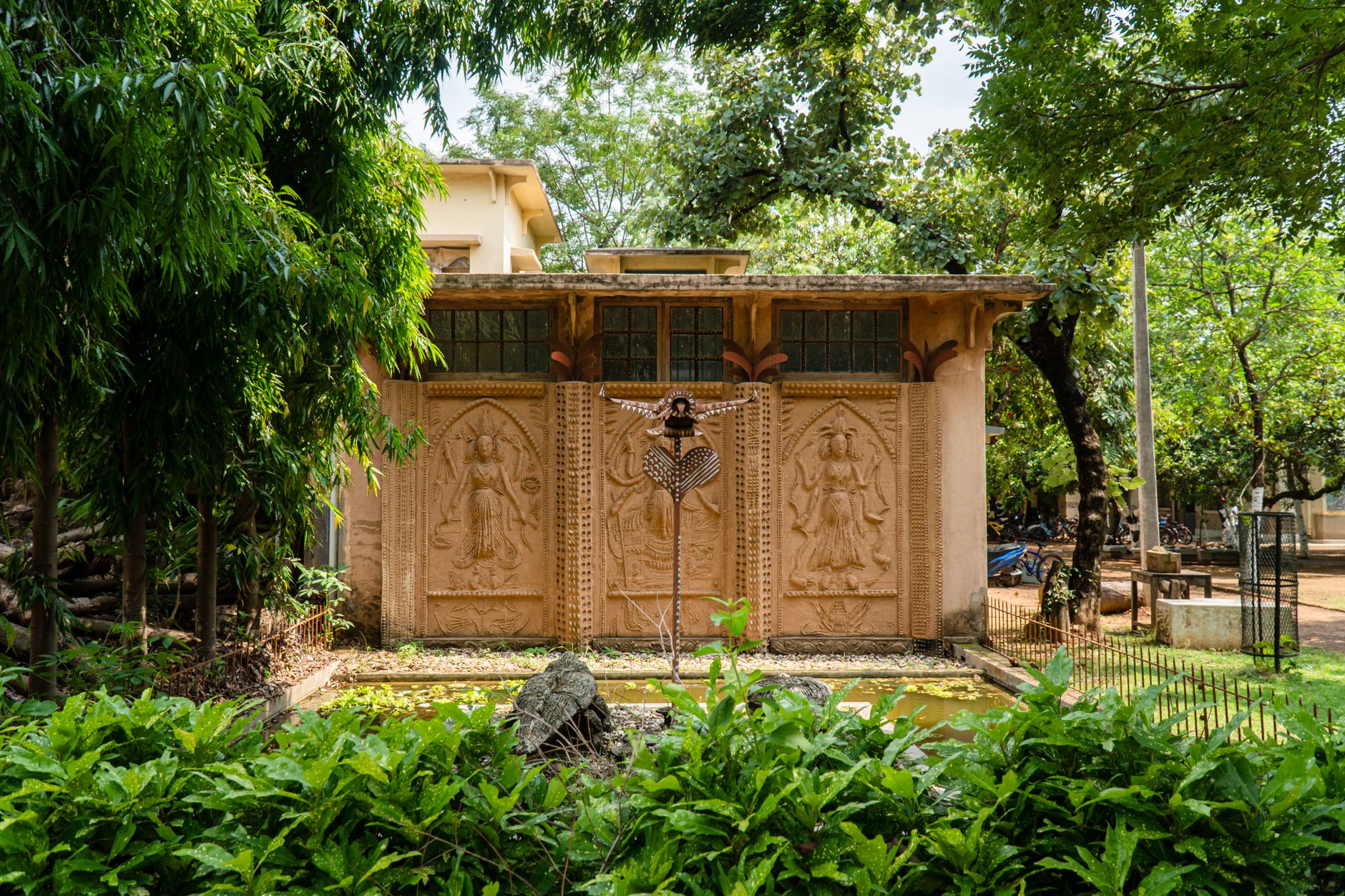
Shantiniketan is Tagore's university town in Birbhum district, a train ride of roughly two and a half to three and a half hours from Howrah to Bolpur. Visva-Bharati, the Uttarayan complex, Kala Bhavana and the Sonajhuri haat fill a day and a half. One night is recommended so the campus and the Saturday market are not rushed.
What Shantiniketan is known for
Shantiniketan began as an experimental school run by Rabindranath Tagore and grew into Visva-Bharati, a university with a reputation for open-air teaching. UNESCO added the place to the World Heritage list in 2023. The town sits in Birbhum district, west of the Hooghly, where the soil is red laterite and the air is dusty before the monsoon. Teaching has long been linked to classes held under trees rather than in halls, and visitors come to see the setting.
The town is small and much of it can be covered on foot, though the campus spreads across several clusters linked by dusty lanes. Uttarayan, Kala Bhavana, the haat ground and the main shopping strip sit within a few kilometres of each other, and auto-rickshaws or cycle rickshaws cover the gaps. The appeal lies as much in the countryside, the red gullies and the quiet as in the buildings. Two days gives room to slow down.
How do you get to Shantiniketan from Kolkata?
Bolpur is the railway station for Shantiniketan, and direct trains run from Howrah through the day. The journey takes roughly two and a half to three and a half hours depending on the service. Seats go quickly at weekends and around the winter fairs, so book both legs in advance through Indian Railways. Early morning departures leave the day free for the campus. Check IRCTC for current timings before fixing dates.
From Bolpur station, auto-rickshaws and cycle rickshaws wait outside for the run to the campus and the guesthouse clusters. Agree the destination before setting off, since the town and the campus have separate stops. Coming by road from Kolkata takes several hours and depends heavily on traffic leaving the city. The train is the simpler choice for most visitors, and a car earns its place only when the plan includes villages across Birbhum.
- Train from Howrah: Direct services to Bolpur run through the day; check Indian Railways for current timings.
- Bolpur station: Auto-rickshaws and cycle rickshaws wait outside for the run to the campus.
- By road: A car from Kolkata takes several hours and depends on traffic leaving the city.
- Return leg: Book the return train early, especially for weekends and the winter fairs.
When is the best time to go
November to February is the comfortable window, with cool mornings, dry roads and a campus that is easy to walk. December brings Poush Mela and a sharp rise in visitors. The fair follows the Bengali calendar and its dates shift each year, so check the current year's dates with West Bengal Tourism before booking. Rooms and trains are busiest across the fair week. A weekday in January is quieter and the light suits the murals.
March to May is hot, with temperatures pushing past 35°C, red dust over everything and evening storms that arrive suddenly. The monsoon runs roughly June to September and turns the countryside green, though paths flood and the haat thins out. October rains taper and November is dry again. Holi, and with it Basanta Utsav, falls in March, so check the current year's dates.
Inside Visva-Bharati and Uttarayan
Visva-Bharati was founded by Tagore in 1921 and became a university in 1951. The Uttarayan complex holds the houses where he lived, several of them kept as memorial museums, and Rabindra Bhavana keeps manuscripts, letters, paintings and personal objects. Opening days change with the university calendar and the museum closes on some weekdays, so check with Visva-Bharati before travelling. Allow half a day for this part of the campus alone.
This is a working university rather than a museum campus. Teaching continues through the year, and some buildings, halls and studios are closed to visitors or open only with permission. Quiet and modest dress go a long way, and asking before photographing people or classes is expected. Guards at the main gates can say what is open that day, and the paths are marked well enough for a self-guided walk.
- Rabindra Bhavana: Museum holding Tagore's manuscripts, letters and paintings; check opening days with Visva-Bharati.
- Uttarayan: The cluster of houses where Tagore lived, several kept as memorial museums.
- Kala Bhavana: The art school, with murals and sculpture standing outdoors among the trees.
- Sangit Bhavana: Music and dance teaching continues here, and rehearsals carry into the surrounding lanes.
- Campus etiquette: Ask before photographing classes, and keep quiet near teaching spaces.
Kala Bhavana murals and sculpture
Kala Bhavana is the art school Tagore set up within the university, and its grounds work as an open gallery. Murals cover the walls of several buildings, and sculptures stand among the trees and lawns, made by teachers and students over the past century. Interiors keep shorter hours than the grounds. Most outdoor work can be seen on foot during daylight, and the school gate is the place to ask about studios and exhibitions.
The school runs its own teaching programme, so studios and workshops can be busy with students. A walk past the murals, the sculpture court and the exhibition spaces takes an hour or two at an unhurried pace, and the light is best in the morning and late afternoon. Carry water, since shade is uneven and the ground is dusty for much of the year. Flat shoes help on the gravel paths.
Sonajhuri forest and the Saturday haat
Sonajhuri, also called the Khoai area, is the wooded ground near the campus, known for its red laterite gullies and the trees that give the place its name. On Saturdays a haat sets up along the paths with leatherwork, textiles, metalware, wooden toys and food stalls, and baul singers perform through the day. The market runs from morning into the afternoon. On other days the ground is quiet and the stalls are mostly gone.
Paths are sandy and uneven with little shade at midday, so go early, wear covered shoes and carry water. Cash helps for small purchases, since not every stall takes a card. The ground is fragile: take rubbish away and stay on the tracks. Ask before photographing stallholders and performers. Winter Saturdays bring the largest crowds, and the lanes back to the campus fill with vehicles by mid-afternoon.
Poush Mela and Basanta Utsav
Poush Mela falls in late December, on the first day of the Bengali month of Poush, and runs for several days. It began as a Brahmo festival and now mixes crafts, baul and folk music, food stalls and a large rural market. Dates move with the Bengali calendar, so check the current year's dates with West Bengal Tourism. The town and the trains are crowded for the whole fair, and mornings are the easiest time to walk the stalls.
Basanta Utsav marks Holi on the campus, with students in yellow, Tagore songs, dance and colour. It falls in March, following the Holi date, so check the current year's dates. Arrive early, since the programme starts in the morning and the grounds fill quickly. Visitors are welcome as spectators; the event belongs to the university, and the usual campus courtesies apply. Colour stains clothing, so dress accordingly.
- Poush Mela: Late December fair with crafts, folk music and food; dates follow the Bengali calendar.
- Basanta Utsav: Held at Holi, when students mark spring with music and colour on the campus.
- Book ahead: Fairs fill the trains and the guesthouses, so fix travel and a bed early.
- Crowds: Roads and campus paths are busy through fair days; mornings are easier.
Should you stay a night?
One night is the sensible minimum for Shantiniketan from Kolkata. It allows a morning on the campus, an afternoon at Sonajhuri and an unhurried return the next day. A day trip works on an early train, but it leaves roughly four hours on the ground and no margin for a delayed service. Two nights suit anyone wanting the villages or a Saturday haat.
Places to stay run from university guesthouses to small private guesthouses in the town and around Bolpur, and none of them are large. Book ahead for December, Holi and long weekends, when the town fills. Ask about the walk to the campus before choosing, since some lanes have no street lighting after dark, and arrange the ride back to the station the evening before.
Practical notes for the trip
Carry cash for the haat, small eateries and rickshaws. UPI and cards work in Bolpur town shops and in most guesthouses, but not at every stall. Simple Bengali food is easy to find near the campus and around the station, with vegetarian thalis, sweets and tea the reliable choices. Filtered water, a hat and dust-friendly shoes make the days easier, and winter mornings are cold enough for a layer.
Photography rules vary between buildings on the campus, and some interiors are closed to cameras. Modest clothing helps at the prayer hall and in the villages. Mobile signal is patchy in the lanes around Sonajhuri. On the return day, leave time to reach Bolpur station and confirm the train through Indian Railways. Tagore's Kolkata house, Jorasanko Thakurbari, pairs well with the trip.
FAQ
How long does the train from Kolkata to Shantiniketan take?
Direct trains run from Howrah to Bolpur, the station for Shantiniketan, and the journey takes roughly two and a half to three and a half hours depending on the service. Timings and availability change, so check Indian Railways (IRCTC) before fixing dates. Early departures leave the most daylight for the campus.
Can Shantiniketan be visited as a day trip from Kolkata?
A day trip works only on an early train, and it leaves roughly four hours on the ground before the return service. That covers a quick campus walk and one other stop at most. A night is better, since it allows a morning at Visva-Bharati and an afternoon at Sonajhuri, with margin for delays.
What can you see at Visva-Bharati in Shantiniketan?
The Uttarayan complex holds the houses where Tagore lived, several kept as memorial museums, and Rabindra Bhavana displays his manuscripts, letters and paintings. Kala Bhavana shows murals and outdoor sculpture made by teachers and students, and the grounds are planted with trees and open spaces. Opening days vary, so check with Visva-Bharati.
When is Poush Mela held in Shantiniketan?
Poush Mela falls in late December, beginning on the first day of the Bengali month of Poush, and runs for several days. Because the Bengali calendar moves against the Gregorian one, the dates shift each year. Check the current year's dates with West Bengal Tourism, and book trains and a bed early, since the town fills.
When is Basanta Utsav in Shantiniketan?
Basanta Utsav is held at Holi, in March, on the Visva-Bharati campus. Students dress in yellow and mark spring with Tagore songs, dance and colour, and visitors watch from the grounds. Holi follows the lunar calendar, so the date changes each year. Check the current year's dates before booking travel.
Is the Saturday haat at Sonajhuri part of a Shantiniketan visit?
The haat at Sonajhuri runs on Saturdays, with leatherwork, textiles, metalware, wooden toys and food stalls along the paths, plus baul singers through the day. It is the liveliest market in the area and worth timing a Shantiniketan trip around. On other days the ground is quiet and the stalls are mostly gone.
Which station serves Shantiniketan and how do you reach the campus?
Bolpur is the station for Shantiniketan, served by direct trains from Howrah. Auto-rickshaws and cycle rickshaws wait outside for the run to the campus and the guesthouses, so agree the destination before setting off. Check Indian Railways for current services, and book the return leg at the same time.
Is Shantiniketan worth visiting in the monsoon?
The monsoon runs roughly June to September and turns the Birbhum countryside green, with fewer visitors and easier rooms. Paths flood after heavy rain, the haat is thin, and walking the campus is muddy work. October rains taper and November is dry and comfortable, so the months either side suit most visitors better.
What should you carry for a day in Shantiniketan?
Carry cash for the haat, rickshaws and small eateries, since not every stall takes a card. Water, a hat and dust-friendly shoes help on sandy paths with uneven shade. A layer suits cool winter mornings, and modest clothing is sensible at the prayer hall and in the villages. Keep the return ticket to hand.
Read next
Sources: Indian Railways (IRCTC), West Bengal Tourism, Visva-Bharati, UNESCO.
Editorial review: 3 November 2026. Opening days, fares and festival dates change; check before you go.