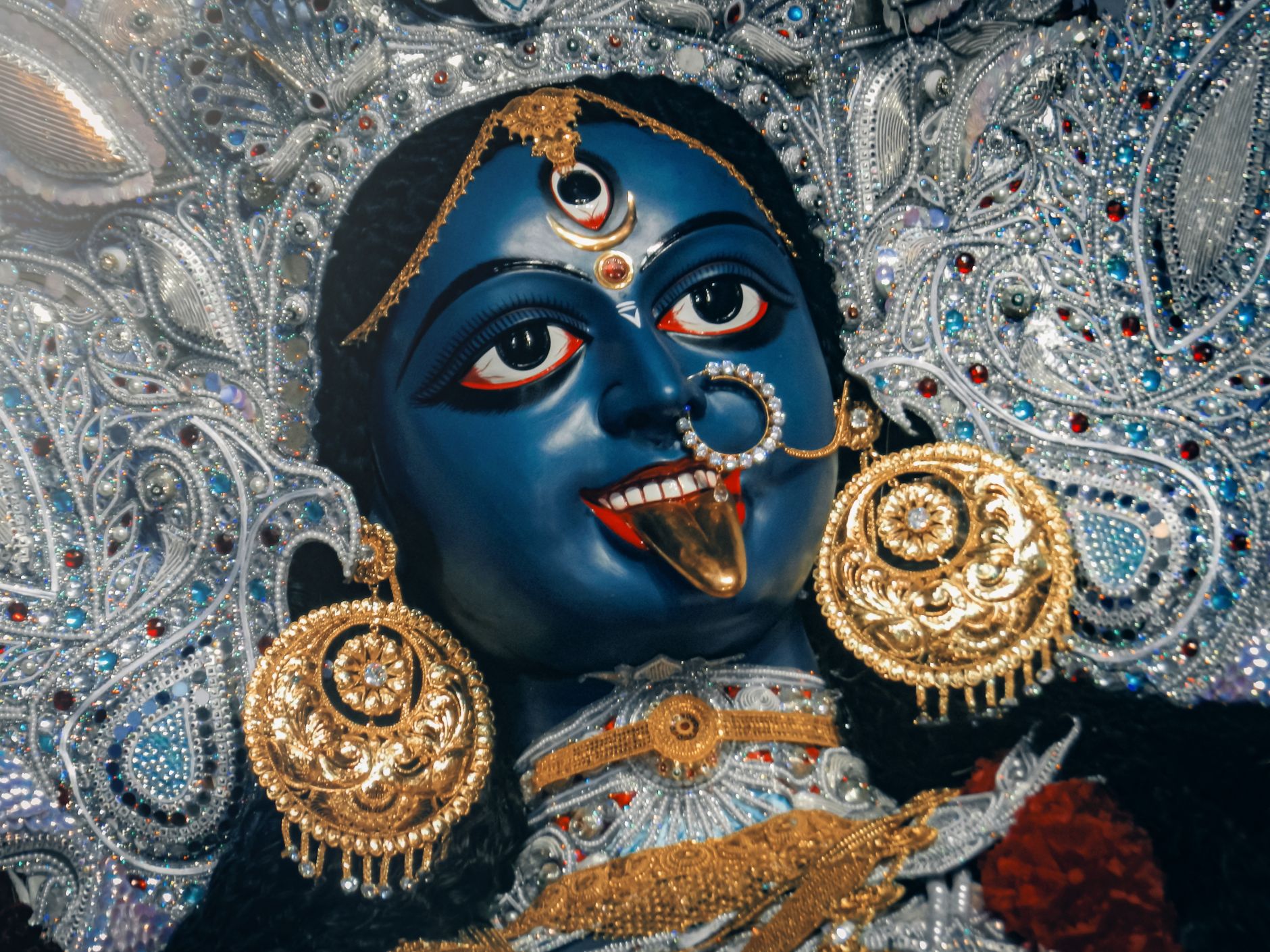
Kali Puja falls on the new-moon night of Diwali, usually in late October or early November, and honours the goddess Kali rather than Lakshmi. Kalighat and Dakshineswar draw the largest crowds, while neighbourhood pandals run late into the night. Expect lamps, fireworks, closed roads and heavy noise. Check the current year's date with West Bengal Tourism before planning.
When is Kali Puja in Kolkata?
Kali Puja falls on the new-moon night of Diwali, the amavasya that closes the fortnight which follows Durga Puja. In most years the date lands in late October or early November, but the lunar calendar moves it, so check the current year's date before booking travel. The night comes a few days after Lakshmi Puja and is given to Shyama, another name for Kali, rather than to Lakshmi. Households with a Kali image do their puja after dark, often close to midnight.
The order of the season matters when planning. Durga Puja comes first, then Lakshmi Puja a few days after Vijaya Dashami, then Kali Puja on the Diwali amavasya. A few neighbourhoods hold their Kali puja on a slightly different date, following family or barowari custom, so a single citywide calendar does not cover everything. Pandals usually stand for one or two nights only and come down soon after immersion. Watch local signage and ask at your accommodation for the lanes near you.
What happens on Bhoot Chaturdashi?
Bhoot Chaturdashi falls on the night before Kali Puja, the fourteenth day of the waning moon. Households light fourteen lamps, usually small clay diyas, along thresholds, windows and dark corners, and cook fourteen kinds of leafy greens. The lamps are set out for ancestors, and the greens, called choddo shak, go on the evening plate. It is a domestic observance rather than a public one, though the lamps are visible from the street in residential lanes. Many families treat it as the start of the festival proper.
For a visitor the night is quiet and mostly private. Walking a residential lane in North Kolkata, or in the older parts of the south, after dusk shows rows of lamps at doorways and the smell of greens cooking. Nothing is ticketed and nothing is organised. Photographs of doorways are fine where they do not intrude on a family at prayer. Fireworks on this night are common but lighter than on Kali Puja itself, and local rules still apply.
Are Kalighat and Dakshineswar busy?
Both temples are extremely busy on Kali Puja night. Kalighat, the Shakti Peetha in south Kolkata where the present temple dates from 1809, draws long queues from the evening, and the lanes around it close to traffic for long stretches. Dakshineswar, the Kali temple completed in 1855 and associated with Ramakrishna, stays crowded through the night and into the next morning. Allow far more time than on an ordinary day. Both are working temples, not visitor sites, and the crowd is there to pray.
Queues at Kalighat can run for hours and the inner sanctum is a crush. Visitors who want darshan without the worst of it often go early on the following morning instead. Dress modestly, keep valuables close and expect to leave shoes outside. Photography inside is restricted. Dakshineswar is on the Blue Line, which ends there, and the last stretch from the station is on foot. Check festival timings with the temple authorities before setting out.
Where to find neighbourhood Kali pandals
Away from the big temples, the night belongs to neighbourhood Kali pujas. Barowari committees in lanes and at crossings put up small, sometimes startling pandals, with the goddess shown in her fierce form, dark-skinned, garlanded with skulls and standing on Shiva. The scale is smaller than Durga Puja and the crowds are local. Lamps at crossroads and processions with drums are part of the older street tradition, and groups move between pandals late into the night.
The older northern quarters are the best ground, around Shyambazar, Sovabazar and the lanes off the main roads, with smaller clusters across the south. Pandal-hopping on foot works better than by car, because roads close and diversions appear without notice. Expect noise from generators, loudspeakers and firecrackers. Local volunteers manage queues and crossings, and their instructions are worth following. Carry a torch for side lanes and keep a meeting point in mind if the group splits.
- Start early: Pandals open around dusk and are calmest before the evening crowds build, usually by nine.
- Walk the lanes: Sovabazar and Shyambazar reward slow walking, with lamps and small pandals at many corners.
- Ask locally: Committee members and residents know which lanes are lit and which roads the police have closed.
- Carry a torch: Side lanes are uneven and unlit in places, and a torch helps on the walk back.
Fireworks, noise and air quality
Fireworks are the loudest part of the night. Bursts start at dusk and can continue past midnight, with the heaviest spell after the evening puja. What is permitted, and for how long, changes from year to year following pollution board directions and court orders. Check the current notices from Kolkata Police and the West Bengal Pollution Control Board before buying or setting off anything. Green crackers only is a common rule, but it is rarely the whole rule.
Air quality drops sharply on the night itself, and November haze is already a factor in the cooler months. Noise is intense close to pandals and at big crossings. Anyone with asthma, a heart condition or a sensitivity to noise should plan a quiet location for the evening and keep medication to hand. Closing windows helps less than distance does. With children or older companions, watch the lamps from a quieter residential lane rather than a main road.
Getting around on Kali Puja night
Expect road closures around Kalighat, Dakshineswar and the larger pandals, with diversions that shift through the evening. The metro is the reliable option: the Blue Line links Kalighat with the centre and runs on to Dakshineswar at its northern end, and services usually run later on festival nights. Check Metro Railway Kolkata for the current schedule. Yellow taxis are metered, and the meter should be running before the car moves.
Walking is often faster than any vehicle for short hops between pandals. The Hooghly ferries run between Howrah, Babughat, Shobhabazar, Bagbazar and Dakshineswar, but night services thin out and should not be relied on after dark. Hand-pulled rickshaws still work some old-city lanes. Police barricades go up early on main roads, so plan a route on foot and a meeting point in case a group separates. Keep the evening to two or three pandals rather than a long list.
- Use the metro: The Blue Line avoids closed roads and links Kalighat, Esplanade and Dakshineswar through the night.
- Fix a meeting point: Phone networks slow under load and groups separate quickly in temple crowds.
- Avoid driving: Parking near Kalighat and Dakshineswar is effectively unavailable on Kali Puja night.
- Plan the return: Last services run earlier than the crowds disperse, so agree a late route in advance.
What to eat during Kali Puja
Sweet shops sell Kali Puja specialities through the week, and nolen gur sweets begin to appear as the weather cools. Expect sandesh, rosogolla and mishti doi, along with seasonal items made from date palm jaggery. Restaurants in the centre stay open late, and Park Street is lively across the Diwali period. For a proper sit-down meal on the night itself, reserve a table in advance, since many places fill quickly with families and groups.
Street food is at its busiest. Phuchka stalls, kathi roll counters and tea shops near pandals do steady business until late, and bhanr tea is easy to find. Nizam's near New Market is credited with the original kathi roll and makes a practical stop in the centre. Vegetarian food is widely available. Many families eat at home during the festival, so a few smaller kitchens shut for the night, and it pays to have a second choice in mind.
What follows Kali Puja in Kolkata
Bhai Phonta, the Bengali brother-and-sister observance, follows within two days of Kali Puja. Sisters mark their brothers' foreheads with sandalwood paste and feed them sweets, and households travel across the city for it. Offices often thin out on the day. For a visitor it is quiet, with light traffic and little to see beyond family gatherings and shops selling sweets and gifts. It is not a public festival and needs no planning.
Jagaddhatri Puja comes soon after, and Chandannagar, the former French settlement about 35 km up the Hooghly, is the place to see it. The town's pandals and light displays draw visitors from across Bengal, and the crowds are heavy on the main nights. Suburban trains from Howrah take roughly an hour. Dates follow the lunar calendar, so check the current year's schedule with West Bengal Tourism and Indian Railways before setting out.
- Bhai Phonta: Falls within two days of Kali Puja and stays a family occasion rather than a public event.
- Jagaddhatri Puja: Chandannagar's light displays follow Kali Puja by days and draw heavy crowds.
- Chandannagar trains: Suburban services from Howrah take about an hour; check the current timetable with Indian Railways.
FAQ
When is Kali Puja in Kolkata?
Kali Puja falls on the new-moon night of Diwali, which usually lands in late October or early November. The lunar calendar shifts the date each year, so check the current year's dates with West Bengal Tourism before planning a trip. The night comes a few days after Lakshmi Puja and closes the autumn festival season in the city.
Is Kali Puja held on the same night as Diwali in Kolkata?
Yes. In Kolkata the Diwali amavasya is Kali Puja, and the goddess Kali is the focus rather than Lakshmi. Homes and pandals keep lamps and fireworks, as elsewhere in India, but the religious centre of the night is a Kali temple or a neighbourhood Kali puja. A few households keep Lakshmi images alongside.
How busy is Kalighat temple on Kali Puja night?
Very busy. Queues form from the evening and the lanes around the temple close to traffic for long stretches. The inner sanctum is a crush and waiting times run into hours. Many visitors choose early morning on the following day instead. Check current timings with the temple authorities, as they change for the festival.
What is Bhoot Chaturdashi in Kolkata?
Bhoot Chaturdashi is the night before Kali Puja, on the fourteenth day of the waning moon. Households light fourteen clay lamps at doors and windows for ancestors and cook fourteen kinds of leafy greens, known as choddo shak. It is a domestic observance, visible from the street in residential lanes, with no tickets and no public events.
Are fireworks allowed in Kolkata on Kali Puja night?
Rules change each year. Permitted types, typically green crackers, and the hours when they may be burst are set by pollution board directions and court orders, and enforced by Kolkata Police. Check the current notices from Kolkata Police and the West Bengal Pollution Control Board before buying or setting off anything. Air quality worsens sharply on the night itself.
Is Kali Puja a good time to visit Kolkata?
It is a striking time if you accept crowds, noise and closed roads. Lamps and pandals are everywhere, the weather is usually comfortable, and the temples are at their busiest. It is a poor choice for anyone with breathing difficulties or a dislike of loud noise. Book accommodation early and plan to move on foot after dark.
How do you reach Dakshineswar on Kali Puja night?
The Blue Line of the metro runs to Dakshineswar at its northern end, and that is the most reliable option when roads close. Services usually run later on festival nights, but check Metro Railway Kolkata for the current schedule. Suburban trains also serve the area. Driving or taking a cab means long delays and almost no parking near the temple.
What happens in Kolkata after Kali Puja?
Bhai Phonta follows within two days, a family observance when sisters mark their brothers' foreheads and offer sweets. Jagaddhatri Puja comes soon after, and Chandannagar, about 35 km up the Hooghly, is the best place to see it, with large light displays and heavy crowds. Dates follow the lunar calendar, so check the current year's schedule before travelling.
Where can you see Kali Puja pandals in Kolkata?
The older northern quarters are the best ground: around Shyambazar, Sovabazar and the lanes running off the main roads there. Smaller pandals also appear at crossings across the south. Start at dusk, walk rather than drive, and follow the crowds and the sound of drums. Local committees can tell you which lanes are lit.
Read next
Sources: West Bengal Tourism, Kolkata Police, West Bengal Pollution Control Board, Metro Railway Kolkata.
Editorial review: 3 November 2026. Opening days, fares and festival dates change; check before you go.