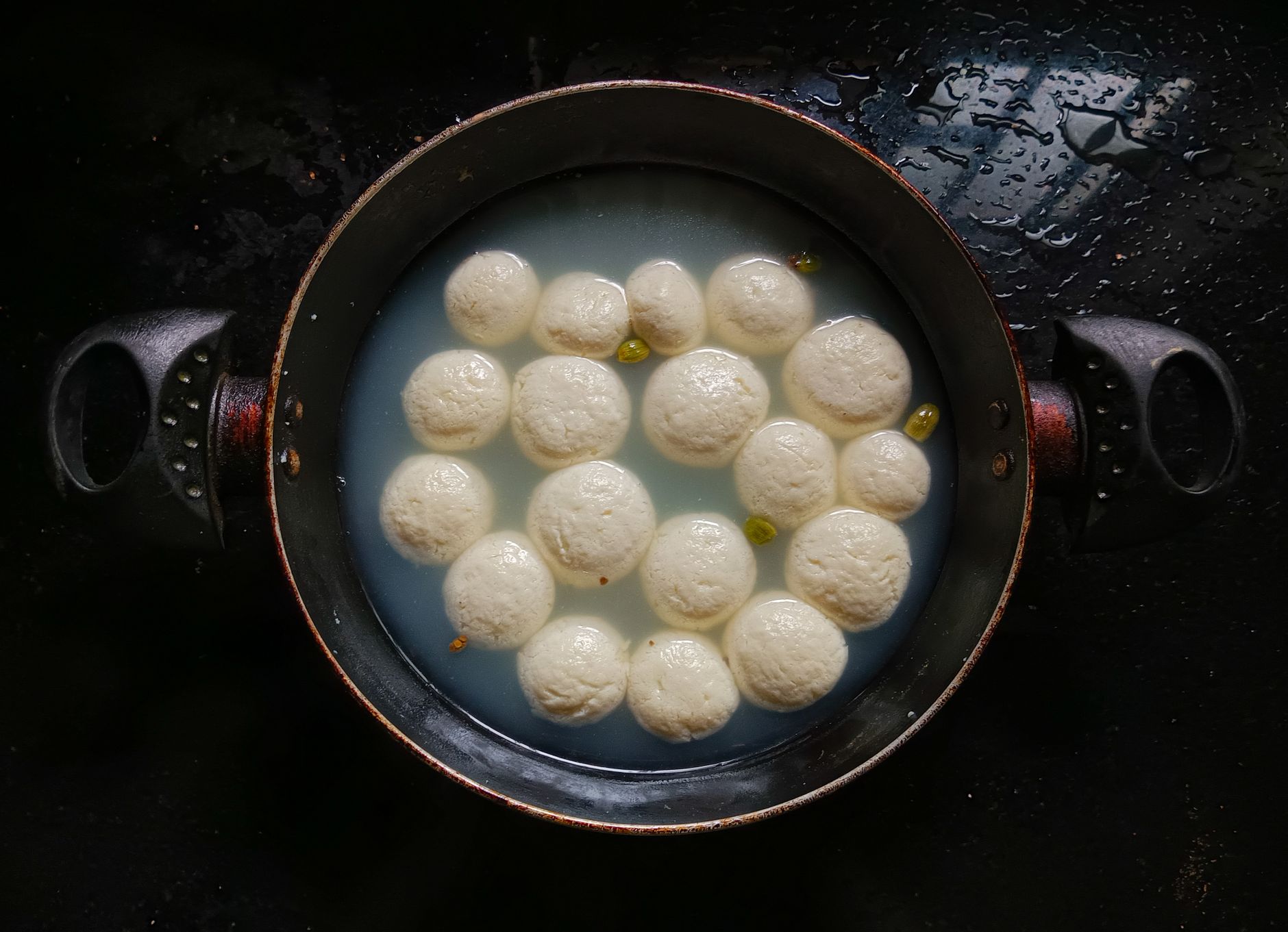
Kolkata sweets are built on chhana, the fresh curd cheese made from milk, and on thickened milk. Rosogolla and sandesh come from chhana; mishti doi is set in a clay pot. Banglar Rosogolla holds a geographical indication tag granted in 2017. Winter brings nolen gur and Joynagarer moa. Shops sell by the piece or in mixed boxes, and chhana sweets are best eaten within a day or two.
What are Kolkata's classic sweets?
Bengali sweets divide into two families. One is built on chhana, the fresh curd cheese made by curdling milk and draining off the whey: rosogolla, sandesh, pantua and chomchom come from it. The other is built on thickened milk: mishti doi, payesh and rabri. Chhana is best used on the day it is made, so most shops sell in morning and evening batches rather than holding stock overnight. Nothing here is designed to keep.
The sweets are eaten at the end of a meal, in the afternoon with tea, and on any social visit. Carrying a box when you call on someone is the ordinary custom, and a mixed box of sandesh and rosogolla covers most occasions. Shops range from old family concerns with a single counter to modern air-conditioned outlets, and both sell the same repertoire. Quality depends on turnover more than on decor, so watch what the counter is selling fastest.
Why does Banglar Rosogolla have a GI tag?
West Bengal received a geographical indication tag for Banglar Rosogolla in 2017, recognising the West Bengal version of the sweet: balls of chhana, lightly kneaded, cooked in clear sugar syrup and sold soft and pale. The tag settled a long argument with Odisha, where a different rasagola is made. The label describes a regional method, not one shop or one recipe. Sponginess comes from the kneading and the syrup, not from raising agents.
A good rosogolla gives slightly when pressed and springs back; a stale one is dense or collapses in the syrup. It is sold warm or chilled, usually in a covered tray of syrup, and is eaten within a day or two. Some shops also sell a caramel-coloured version made by cooking the syrup down, which has a deeper flavour and a firmer bite. Ask for the fresher batch if the tray has been standing.
What are the main kinds of sandesh?
Sandesh is chhana kneaded with sugar and cooked just enough to hold its shape. The two broad classes are norom pak, soft and lightly cooked, and kora pak, firmer and cooked longer. Soft sandesh is eaten the same day; the firm kind keeps a little longer and is often moulded into shapes or stamped with a design. Both are less sweet than rosogolla, and kanchagolla is the plainest member of the family.
Flavour comes from what is folded into the chhana: nolen gur in winter, cardamom, pistachio, mango in summer, or a little cocoa. Jolbhora sandesh carries a pocket of syrup inside and needs care when bitten. Texture is the point of the whole family, so buy from a shop with fast turnover and check that the surface is neither cracked nor weeping. Fresh sandesh smells of warm milk, not of the refrigerator.
- Kanchagolla: The plain white chhana ball, barely sweetened, eaten fresh and rarely kept overnight.
- Norom pak: Soft, pale sandesh cooked only briefly, best eaten on the day it is bought.
- Kora pak: Firmer sandesh with a closer crumb, often moulded and the better choice for travel.
- Jolbhora: A round sandesh with syrup sealed inside, so it bursts when bitten.
- Nolen gurer sandesh: The winter version, darkened and flavoured with date-palm jaggery rather than sugar.
What makes mishti doi different?
Mishti doi is milk boiled down, sweetened, cooled and set with a little culture in an unglazed clay pot. The pot absorbs moisture as the curd sets, which firms the texture and leaves a faint pink or caramel colour on top. It is served cold, often straight from the pot, and eaten at the end of a meal or after a long afternoon. It is a set curd, not a baked custard, and it should hold a spoon without running.
The sweetness is heavy by design, because the doi is eaten in small quantities. Plain mishti doi is the usual order; some shops sell a version with fruit or with a layer of cream on top. In hot weather it is the most refreshing of the milk sweets. It keeps in a refrigerator for a few days, though the clay pot goes on drawing moisture and the surface will eventually weep.
When is nolen gur season?
Nolen gur is the jaggery made from the sap of date palms tapped in the cool months, roughly December to February in the districts around Kolkata. Early in the run it is a thin liquid, jhola gur; later it sets into blocks, patali gur. Both have a smoky, resinous flavour that sugar cannot copy, and both go into sandesh, payesh, rosogolla and the winter pithe. The liquid form has the stronger flavour and the shorter life.
The season is short and it moves with the weather. Shops start selling nolen gur sweets when the first sap is boiled down and stop when the palms stop giving, so the exact weeks shift from year to year. Ask what has arrived that morning rather than assuming the whole winter is the same. Joynagarer moa, puffed kanakchur rice bound with gur, comes from Joynagar in South 24 Parganas and appears in the same weeks.
Which other sweets are worth trying?
Beyond the famous two, the shops sell a long list of chhana sweets. Pantua is a fried milk dumpling in syrup, close to a gulab jamun but softer. Langcha is its oblong cousin, drier on the outside and heavier. Chomchom is a syrupy, ridged sweet often rolled in sugar, and rajbhog is the large, saffron-tinted one with a stuffing at the centre. Sitabhog and mihidana are the grainy sweets of Bardhaman district.
There are non-milk sweets too. Jilipi is a spiral of batter fried and soaked in syrup, made in the mornings. Naru, til and moa are built on rice, sesame and jaggery and belong to the winter and to festivals. These keep better than chhana sweets and travel more safely, which matters if you are carrying something home. Many shops sell them from a tray beside the counter rather than from the display case.
- Pantua: A fried chhana dumpling soaked in syrup, softer and heavier than it looks.
- Langcha: The oblong cousin of pantua, darker outside and dense within.
- Chomchom: A ridged, syrupy sweet often rolled in sugar or coconut.
- Rajbhog: The large one, tinted with saffron and stuffed at the centre.
- Sitabhog and mihidana: Grainy sweets from Bardhaman district, usually sold together and lighter than they look.
How do you buy sweets in Kolkata?
Most sweets are sold by the piece, and boxes are made up to order. Say how many people you are buying for and let the shop choose the mix; a standard box holds a few kinds rather than a kilo of one. Rosogolla and other syrup sweets should be packed separately from sandesh, because the syrup softens anything it touches on the way home. Shopkeepers expect to be asked and will steer you towards what is fresh that day.
Chhana sweets are perishable. Sandesh is at its best within a day, rosogolla within two if kept cool, and mishti doi a little longer in a refrigerator. Dry sweets, moa and naru keep far better. If you are carrying sweets out of the city, say so at the counter and ask for the firm, dry kinds and tight packing. Small boxes travel better than one large one.
- By the piece: Ordering one of each is normal and lets you compare textures across the counter.
- Ask for a mix: A box of three or four kinds suits a visit better than a single large box.
- Keep them separate: Syrup sweets and dry sandesh need their own containers, or the sandesh will soften.
- Say if travelling: The shop can pack firm sweets for a journey and leave out the ones that will not last.
Sweets at Durga Puja and Poila Baisakh
Durga Puja, usually in late September or October, is the busiest time in the sweet shops. Families buy boxes to take when visiting relatives and pandals, and shops work long hours to keep up. The pandal bhog is a separate matter, cooked in huge quantities and shared out. Sweets are also offered at some household pujas and given away afterwards. Check the current year's dates with West Bengal Tourism before planning a trip around the festival.
Poila Baisakh, the Bengali new year in mid-April, starts with something sweet in most households. Shops open with fresh stock and the counter is busier than usual through the morning. The rest of the year has its own pattern: heavy milk sweets at weddings, mishti doi through the hot months, fried sweets during the monsoon, and gur sweets once the cold arrives. A birth, a wedding or a house move is marked with a box.
Poush Sankranti in mid-January belongs to pithe and payesh made with nolen gur, and Saraswati Puja in January or February is another sweet-heavy day. Kali Puja and Diwali, in October or November, come at the start of the gur season. Festival dates move with the lunar calendar, so check the current year's dates with West Bengal Tourism before you plan a visit around one of them.
FAQ
Which Kolkata sweets should a first-time visitor try?
Start with a plain rosogolla, a norom pak sandesh and a pot of mishti doi, which between them show the three main textures. Add pantua or chomchom if you want a fried or syrup-heavy sweet. In winter, ask for anything made with nolen gur, and look for Joynagarer moa in the same weeks.
How long do Kolkata sweets stay fresh?
Chhana sweets are the most fragile. Sandesh is best on the day it is bought and should be eaten within a day or two. Rosogolla keeps for about two days if refrigerated in its syrup. Mishti doi lasts a few days in a refrigerator. Dry sweets such as moa, naru and jilipi keep much longer.
Can you carry Kolkata sweets home on a flight?
Firm kora pak sandesh, chomchom and dry sweets such as moa travel best, packed tightly in a box. Rosogolla in syrup and mishti doi in clay pots are awkward and may leak. Ask the shop to pack for a journey, keep the box out of the sun, and check the airline's cabin rules before carrying food through security.
Is mishti doi the same as sweetened yoghurt?
It is close, but the method differs. Mishti doi is milk boiled down to thicken it, sweetened heavily, then set with culture in an unglazed clay pot, which draws out moisture and gives a firm set and a pinkish top. Ordinary sweetened yoghurt is set in plastic or glass and stays looser and paler.
When can you buy nolen gur sweets in Kolkata?
Nolen gur sweets appear when the date palms are tapped, usually from the second half of December, and disappear by February or earlier if the sap run ends. The weeks shift with the weather each year, so ask in the shop what has arrived rather than relying on a fixed date.
What is joynagarer moa and when is it sold?
Joynagarer moa is a winter sweet from Joynagar in South 24 Parganas. Puffed kanakchur rice is bound with nolen gur into a sticky, chewy ball. It appears when the gur season begins and is sold in the same weeks as gur sandesh, often from trays rather than from the main display.
Are Kolkata sweets suitable for vegetarians?
Yes, almost all of them. Chhana is made by curdling milk with lemon juice, whey or another acid, and the sweets are built on milk, sugar, jaggery, rice and nuts. Eggs are not used in rosogolla, sandesh, mishti doi, pantua or chomchom. If you avoid dairy, the moa, naru and jilipi family is the alternative.
Where are the old sweet shops in Kolkata?
North Kolkata has the longest history, with family shops in the lanes around Shyambazar, Hatibagan and College Street. Ballygunge, Gariahat and Kalighat in the south also have long-established counters. Park Street and Esplanade are better for restaurants than for sweets. Wherever you go, pick a shop with a queue and a fast-moving counter.
Do you buy Kolkata sweets by weight or by the piece?
Both are common. Most chhana sweets are counted out by the piece and packed into boxes, while some shops weigh dry sweets and larger items. Say how many people you are buying for and the shop will suggest a mix. Mixed boxes are the usual gift.
Read next
Sources: Geographical Indications Registry, West Bengal Tourism, Food Safety and Standards Authority of India.
Editorial review: 3 November 2026. Opening days, fares and festival dates change; check before you go.