Kolkata eats in a set order: a bitter shukto or a bhaja, then dal, then fish, then meat, then chutney and sweets. Fish means rui, ilish in monsoon and bhetki or prawns for a treat, and mutton kosha and biryani with potato and egg are the meat dishes to know. Street food runs from phuchka to kathi rolls, and Tangra cooks Indian-Chinese.
What is the order of a Bengali meal?
A Bengali meal arrives in a sequence, and the order matters more than any single dish. It opens with something bitter, usually shukto, a vegetable stew with a faint bitterness, or a plain dal. Fried vegetables, called bhaja, come next, then a fish course, then meat if the household eats it, then a chutney and finally sweets. Restaurants often compress the order, but a family lunch at home keeps it.
Rice is the constant, served with dal, and luchi, a small puffed bread of maida, appears with richer dishes. Kosha mangsho, a slow-cooked mutton curry, is eaten with luchi rather than rice. A weekday meal is simpler: dal, a bhaja, one fish curry, and a slice of something sweet. Say yes to a second helping of fish, since it is the polite thing to do and the rice will keep coming.
- Shukto: A bitter vegetable stew, often with bori and a little milk, served first to open the meal.
- Dal and bhaja: Yellow dal with a fried vegetable, usually potato, brinjal or pumpkin, on the side.
- Fish course: A rui or ilish curry in a thin gravy, eaten with plain rice in the middle of the meal.
- Meat course: Mutton kosha or chicken, served after the fish and often with luchi rather than rice.
- Chutney and mishti: A sweet-and-sour chutney clears the palate before mishti doi or sandesh ends the meal.
Which fish should you eat in Kolkata?
Fish is the centre of Bengali cooking, and the names are worth learning. Rui is the everyday carp, usually cooked in a thin gravy or fried and then simmered. Ilish, hilsa, is the prized fish of the monsoon, cooked in mustard oil with mustard seed, and it arrives in markets roughly from June to September. Bhetki, a firm white fish, becomes fish fry and fish cutlet. Prawns, called chingri, are the treat.
Chingri malaikari, prawns cooked in coconut milk, is the dish to order where a kitchen does it well. Fish is cooked in mustard oil, which gives a gravy its heat and colour, and a mustard paste, shorshe, is a common base. Much of the fish reaches the city from the delta rivers and ponds. Ask what came in that morning rather than ordering from the printed menu alone, and let the kitchen choose the cut.
Mutton kosha and Kolkata biryani
Mutton kosha is the meat dish of the Bengali kitchen: goat or mutton cooked slowly until the gravy clings to the pieces, heavy with onion, ginger and garam masala. It is served with luchi, paratha or rice, and it tastes better when made a day ahead. Chicken takes similar gravies, but the kosha method belongs to mutton. Kosha mangsho with luchi is the Sunday lunch to aim for at home.
Kolkata biryani is the other meat dish to know, and it differs from the Lucknow and Hyderabad styles. The rice is lighter, the spices gentler, and every plate carries a whole potato and often a boiled egg, both of which take up the gravy. The potato is not a garnish, and regulars judge a biryani by it. Biryani is eaten at lunch, and rolls are the evening version of the same meat.
Where does Kolkata street food happen?
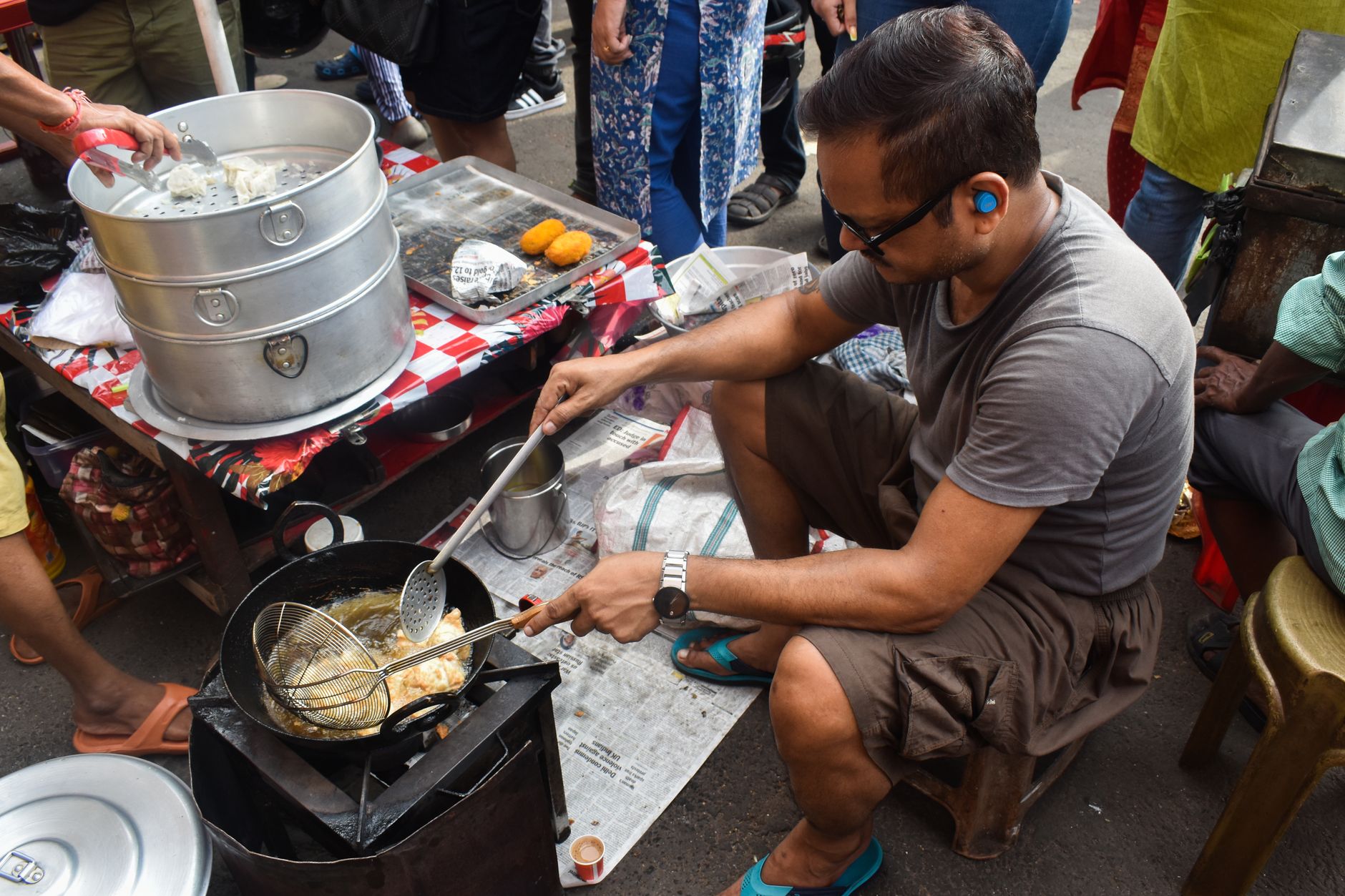
Street food in Kolkata is a whole way of eating, not a snack between meals. Phuchka, the crisp shell filled with spiced potato and tamarind water, is the one to start with, and it is assembled in front of you. Jhalmuri, puffed rice tossed with mustard oil, chilli and lime, comes in a paper cone. Ghugni, a yellow pea curry, is served with chopped onion and a squeeze of lime. Telebhaja, batter-fried vegetables, is best straight from the oil.
Kathi rolls began as a way of eating a kebab without a plate: a paratha wrapped around meat, onion and chilli, with a little lime. Nizam's near New Market is credited with the original. Momos, steamed dumplings, belong to the Tibetan and Nepali stalls around the northern parts of the city and near College Street, and they come with a fierce red chutney. Fried momos are the other order, and they travel better in a bag.
- Phuchka: Crisp shells filled at the counter with potato, chickpea and tamarind water, eaten in three bites.
- Kathi roll: A paratha wrapped around kebab, onion and chilli, the evening snack of the office crowd.
- Jhalmuri: Puffed rice with mustard oil, chilli, lime and sometimes coconut, sold in paper cones.
- Ghugni and telebhaja: Yellow peas in gravy and batter-fried vegetables, the morning and evening stall pair.
- Momos: Steamed or fried dumplings with a hot red chutney, from stalls in the north and near College Street.
Which Kolkata sweets are worth trying?
Bengali sweets are built on chhena, fresh curd cheese, rather than on flour and ghee. Rosogolla is the soft white ball in light syrup, and the canned version sold elsewhere bears little relation to it. Sandesh is chhena worked with sugar and shaped, sometimes plain, sometimes with a little jaggery. Mishti doi is thick sweet curd set in a clay pot, and it is eaten at the end of a meal rather than as a dessert.
Winter brings nolen gur, the date-palm jaggery tapped in the cold months, and sweet shops turn it into sandesh, rosogolla and payesh. It lasts only a few weeks, so it is worth asking for by name in December and January. The other sweet to know is the pantua, a fried syrup-filled ball close to a gulab jamun. Sweet shops are everywhere, and a shop with a queue at eight in the morning is a good sign.
- Rosogolla: A soft chhena ball in clear syrup, eaten warm from the shop in the morning.
- Sandesh: Chhena cooked with sugar and pressed into shapes, plain or flavoured with nolen gur in winter.
- Mishti doi: Sweet thick curd set in a clay pot, the last course of a Bengali lunch.
- Nolen gur sweets: Date-palm jaggery sweets sold from December into January, and gone once the sap stops.
- Pantua and chomchom: Fried syrup sweets, heavier than sandesh, sold by weight in every neighbourhood.
Indian-Chinese food in Tangra and Tiretta Bazaar
Kolkata has its own Chinese cooking, older and milder than the versions found elsewhere in India. Tangra, in east Kolkata, is where the city's Chinese community settled and where the kitchens still work: hakka noodles, chilli chicken, prawn in a garlic sauce. Tiretta Bazaar, the old Chinatown near Central, runs a breakfast market early in the morning with dumplings, noodles and pork. Tangra is a lunch and dinner destination, Tiretta Bazaar a breakfast one.
Indian-Chinese food in Kolkata means a particular grammar: noodles or rice, a chilli or garlic sauce, a Manchurian mode and a sweetcorn soup at the start. It is eaten in family groups, at long tables, and the portions are large. The cuisine is neither Chinese nor Bengali and the city is protective of it. Ask for the day's fish or prawn and the kitchen will usually suggest a sauce to match.
Bakeries, tearooms and bhanr tea
The city's bakeries come from two older communities. Anglo-Indian bakeries sell bread, cakes, puffs and Christmas cake, and the tradition runs through the older shopping streets. Jewish bakeries, of which Nahoum's in New Market is the surviving example, sell fruit cake, cheese and pastries. Flurys on Park Street is the tearoom most visitors know, and it serves breakfast, cake and tea through the day. Park Street also holds Peter Cat, Mocambo and Trincas.
Tea is the everyday drink, and the bhanr, an unglazed clay cup, gives it a faint earthy taste. Roadside stalls pour from a kettle into bhanr and the cup is thrown away after use. Order tea without sugar if you prefer, and say kom chini for less. Indian Coffee House on College Street is the other tea institution, a high-ceilinged room where the waiters still carry trays overhead and the bill is written by hand.
- Flurys: Park Street tearoom for breakfast, cake and a pot of tea in old rooms.
- Nahoum's: New Market bakery for fruit cake, cheese and pastries, run by the city's Jewish community.
- Indian Coffee House: College Street institution for coffee, tea and a long sit-down over a book.
- Bhanr tea: Strong tea in an unglazed clay cup from a roadside stall, drunk in two or three sips.
- Peter Cat and Mocambo: Park Street restaurants for a sit-down lunch or dinner in high-ceilinged rooms.
Planning meals around the city
Where you eat depends on where you are. Park Street and Esplanade hold the old restaurants and tearooms, and they are the easiest place to start on a first evening. North Kolkata, around Shyambazar and the Sovabazar lanes, is where to look for kosha mangsho, luchi and old sweet shops. College Street adds the book market and Indian Coffee House. Ballygunge and Gariahat are for neighbourhood restaurants and Bengali home-style cooking.
Salt Lake and New Town have the newer kitchens, including the Chinese restaurants and the malls, and they suit a visitor staying in that direction. Tangra is next to Salt Lake and worth the detour for a long lunch. Kalighat and the areas around the temple are for a quick meal near a sight, and Howrah, across the river, has its own eating houses near the station. Plan one meal around the area you are already seeing.
How do you eat street food safely?
Street food in Kolkata is generally safe where the stall is busy, and a queue is the best guide. Busy stalls turn their stock over and cook in front of you. Choose hot food from a hot pan, drink sealed bottled water, and skip cut fruit and ice from unknown sources if your stomach is new to the city. Carry hand sanitiser. Vegetarian stalls frying fresh are the safest introduction on a first day.
Phuchka is the one to be careful with, because the water is mixed by hand at the counter. Watch how the vendor handles the shells and the tamarind water before committing. Most visitors are fine. A first week of rich food, mustard oil and chilli takes adjusting, so build up over a day or two rather than starting with a full Bengali lunch on arrival. Bottled water with meals is the simple rule.
FAQ
What should a Kolkata food guide cover for a first visit?
Start with one Bengali lunch in the old order: shukto, dal, a bhaja, a fish curry, mutton kosha and a sweet. Add a phuchka stop, a kathi roll in the evening and one Indian-Chinese meal in Tangra. Sweets and tea fill the gaps. Three days is enough to cover that ground without rushing.
Is Kolkata food very spicy?
Less than the food of Andhra or Chettinad, and the heat sits in specific places: mustard oil and mustard paste in fish curries, green chilli in street snacks, the red chutney served with momos. Bengali home cooking is mild and slightly sweet. Say kom jhal for less chilli, and ask for the chutney on the side.
Can you eat well in Kolkata without meat or fish?
Yes. The Bengali meal order gives vegetables a proper place: shukto, dal, bhaja, a dry vegetable and a chutney make a full lunch, and most Bengali restaurants keep a vegetarian thali. Street food is largely meatless apart from rolls and momos. Indian-Chinese kitchens cook paneer and vegetables in the same sauces, and sweet shops are entirely vegetarian.
When is hilsa available in Kolkata?
Ilish, hilsa, is a monsoon fish, roughly June to September, and it is cooked in mustard oil with mustard paste. Restaurants put it on the menu when the catch is good, so ask before ordering. Outside those months, rui, bhetki and prawns are the better choices on a Kolkata fish menu.
Where can you eat Indian-Chinese food in Kolkata?
Tangra, east of the centre near Salt Lake, is the main area, with family kitchens serving hakka noodles, chilli chicken and prawns in garlic sauce. Tiretta Bazaar near Central runs an early morning Chinese breakfast market. Chinese restaurants also appear in Salt Lake and New Town, and older city restaurants keep a few Indian-Chinese dishes for the lunch crowd.
Which Kolkata sweets should a visitor try first?
Rosogolla and sandesh are the two to start with, bought from a shop with a morning queue. Mishti doi ends a Bengali lunch, and in December and January ask for nolen gur sweets, made from date-palm jaggery. Pantua and chomchom are heavier fried sweets. Buy by weight and eat them the same day, since chhena sweets do not keep.
Is Kolkata street food safe?
Largely yes, if the stall is busy and the food comes hot from the pan. Watch phuchka being assembled, avoid cut fruit and ice from unknown stalls, drink sealed bottled water and carry hand sanitiser. A first day of rich food and mustard oil takes adjusting, so build up slowly rather than eating everything at once.
What is bhanr tea and where is it served in Kolkata?
Bhanr is tea served in a small unglazed clay cup, which is thrown away after one use. Roadside stalls across the city pour it from a kettle, usually with milk and sugar, and the clay gives the tea an earthy taste. Indian Coffee House on College Street is the sit-down alternative for tea and coffee.
How does Kolkata biryani differ from other biryani?
It is lighter and less spiced than the Lucknow or Hyderabad versions, and each plate carries a whole potato and often a boiled egg. The potato takes up the gravy and regulars judge a plate by it. Biryani is a lunch dish in Kolkata, while rolls are the evening street version of the same meat.
Read next
- Kolkata street food: what to eat first
- Kolkata sweets: rosogolla, sandesh and mishti doi
- North Kolkata
Sources: West Bengal Tourism, Kolkata Municipal Corporation, Food Safety and Standards Authority of India.
Editorial review: 3 November 2026. Opening days, fares and festival dates change; check before you go.