 5★
Prinsep Ghat is a public riverfront on Strand Road, built around an 1843 Palladian memorial to the scholar James Prinsep. It faces west across the Hooghly, which makes the last hour of daylight the best time to come. Short country-boat rides leave from the stairs, and Vidyasagar Setu rises directly behind. Allow about an hour.
What is Prinsep Ghat?
Prinsep Ghat is a riverside landing on Strand Road, on the east bank of the Hooghly, between the Howrah Bridge and Vidyasagar Setu. A white stone memorial pavilion in the Palladian style stands at the water's edge, and a paved promenade runs along the river beside it. The ghat is free to enter and is used for evening walks, short boat trips and views across the water to the Howrah bank. It is one of the few central spots where the river is directly reachable on foot, with no wall or road in between.
The name honours James Prinsep, the East India Company assay master and scholar who deciphered the Brahmi script and opened the Ashokan edicts to reading. The memorial was built in 1843, a few years after his death, and it has stayed in use as a landmark rather than a tomb. The ghat itself is a working riverfront: boats tie up, crews wash down, and vendors sell tea, phuchka and snacks through the evening.
Why go at sunset?
Prinsep Ghat faces west across the Hooghly, so the whole width of the river is in front of you when the sun goes down. Light comes off the water, the Howrah bank turns to silhouette, and the white memorial picks up warm colour. The hour before dusk is cooler than the afternoon, and the promenade fills with walkers, photographers and families rather than a crowd. Allow about an hour, which is enough for the memorial, the promenade and a boat if you want one.
Sunset moves through the year, so check the India Meteorological Department records or a sunrise and sunset table for the day rather than fixing a time in advance. In winter the light goes early and the air can be hazy; in the monsoon the river runs high and the sky is often heavy. Clear evenings in November give the sharpest views, though any dry month works. Rain can end a visit quickly, and there is little shelter on the promenade apart from the pavilion itself.
- Before sunset: The white stone and the water are at their best in the half hour before the sun goes down.
- The far bank: Boats, ghats and the Howrah skyline turn to silhouette as the light drops.
- The bridge: Vidyasagar Setu catches the last light on its cables, directly behind the promenade.
- After dark: Lamps come on along the river path and the bridge stays lit well into the night.
The Palladian memorial
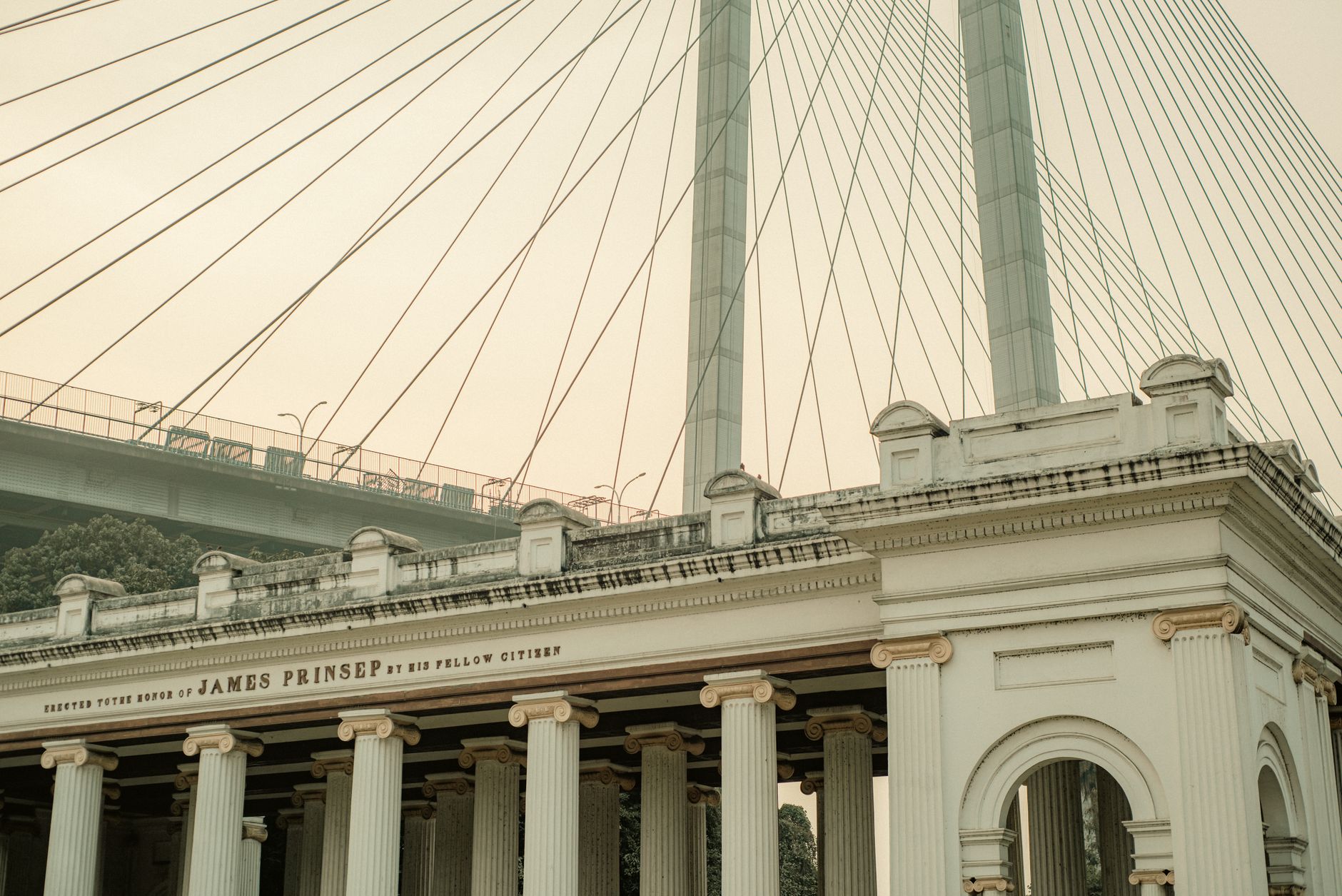
The pavilion is a small Palladian building: a row of columns, a pediment above them, and a covered platform raised over the water stairs. It was designed as a memorial rather than a working building, and it borrows the classical vocabulary that British Calcutta used for its public architecture. The stone has weathered grey, and the structure reads best from the promenade a few metres away rather than from directly underneath, where the columns hide the detail.
Look at the ghat stairs below the pavilion. They are the working part of the site: boats come alongside, ropes are made fast, and the steps stay busy into the evening. Photographs of the pavilion with the river behind it are the standard shot, and the columns frame the water neatly in late afternoon. The monument is a public structure, with no ticket desk and no gate, so it can be visited at any hour.
Vidyasagar Setu overhead
Vidyasagar Setu, the cable-stayed bridge that opened in 1992, carries the second Hooghly crossing just south of the ghat. Its towers and stay cables rise directly behind the promenade, so the view downriver mixes a nineteenth-century memorial with a late twentieth-century bridge. That pairing is why many people come with a camera: old stone in front, steel and concrete behind, and a wide river in between. It is also why the skyline here looks nothing like the rest of Strand Road.
Traffic on the bridge runs late into the night, and the cables catch the last of the light. From the promenade you can follow the crossing from bank to bank without once leaving the river path. Stand under the approach and the scale becomes obvious: the deck runs high above the ghat and the towers sit far out in the water. For closures, diversions or river traffic restrictions, check notices from Kolkata Police before setting out.
Can you take a boat ride?
Country boats work from the ghat through the afternoon and evening, offering short rides on the Hooghly. The boats are small and open, rowed or motored, and a trip usually stays close to the bank between the two bridges. Nothing is scheduled: you turn up, find a boatman at the stairs, and agree the route before you get in. The river is tidal here, so conditions and safe routes change with the state of the tide.
Ask about life jackets before boarding, and accept a shorter route if the tide or the failing light is against a longer one. Boats are not allowed in every stretch of the river, and instructions from the river police take priority over anything agreed on the bank. Children should stay seated and close to an adult. If you would rather stay on land, the promenade gives the same view without the water.
- Agree first: Fix the route and the fare with the boatman before stepping aboard, and repeat it back clearly.
- Life jackets: Ask to see jackets before boarding; not every country boat carries them for every passenger.
- Tide and current: The Hooghly is tidal at Kolkata, so the water and the safe routes change through the day.
- Best light: The last hour before sunset gives the best photographs and the coolest ride on the water.
- River police: Follow instructions from the river police and stay seated while the boat is moving.
How do you get to Prinsep Ghat?
Prinsep Ghat is on Strand Road, south of the Esplanade and BBD Bagh, near the Eden Gardens and Fort William end of the Maidan. The nearest metro stops are Maidan and Rabindra Sadan on the Blue Line, both a walk or a short cab ride away. Taxis and app cabs can drop you at the Strand Road entrance. Check Metro Railway Kolkata for current lines, stations and hours, and allow extra time in the evening rush, when Strand Road slows to a crawl.
A suburban railway halt at Prinsep Ghat, on the Circular Railway, has a limited service, so check Indian Railways before planning around it. From Park Street the drive is short outside peak hours. Walking from the Maidan is possible and pleasant in winter, but the last stretch along Strand Road carries fast traffic and needs care with children. Crossing Strand Road is the awkward part of any approach on foot, and the road is wide.
What else is nearby?
Millennium Park and Babughat sit on the same stretch of Strand Road, both riverside promenades with their own views of the Hooghly and the bridges. Eden Gardens and the Maidan are a short ride inland, and the Victoria Memorial is within easy reach. Fort William is an active military area with no general entry, so the ramparts and the Maidan edge have to be seen from outside. The walk along the river between the ghats is the simplest way to link them.
For food afterwards, Park Street is the obvious run, with Flurys, Peter Cat, Mocambo, Trincas and Nizam's among the long-established names. New Market is close to the Esplanade end for shopping. On foot, the riverside path towards Babughat is the easiest extension of the visit, and it keeps the water in view for most of the way. Allow another hour if you plan to eat, and check opening days around public holidays.
- Millennium Park: Riverside walk and gardens on the same stretch of Strand Road, a few minutes from the ghat.
- Babughat: Ferry point and promenade further along Strand Road, busy through the evening.
- Eden Gardens: Cricket ground on the Maidan; matches and ground tours are ticketed, check with the cricket association.
- Victoria Memorial: Marble monument and museum on the Maidan, closed on Mondays and some national holidays.
- Fort William: Active army base with no general entry; the ramparts and Maidan edge are seen from outside.
Practical points before you go
Wear shoes you can walk in and carry water. The promenade is paved but uneven in places, and there is little shade once the sun turns west. Snack stalls and tea sellers work through the evening, and bhanr tea is the usual order. Public toilets are scarce, so use facilities before arriving. Litter bins are provided, but the bank still collects rubbish after busy evenings. The ghat is free to enter at all hours, with no gate to close.
The riverfront is busiest from late afternoon until well after dark, and the crowd is mostly families, couples and photographers. Keep bags zipped in the crush, avoid the unlit ends of the promenade at night, and take a booked cab back rather than walking a long stretch of Strand Road after dark. Winter mornings can be hazy with poor air quality; evenings are usually clearer. Check Kolkata Police advisories before big events on the Maidan.
Hotels in Park Street
For Prinsep Ghat at sunset, the nearest hotel area is Park Street, with 241 stays in the IMPT hotel database. Listed 5-star first, then 4-star, then by guest score; live prices open in the IMPT app.
5★ 5★
 5★
 5★
 4★
 4★
FAQ
Is Prinsep Ghat free to enter?
Yes. Prinsep Ghat is a public riverfront with no gate, no ticket desk and no fixed opening hours. The memorial pavilion, the promenade and the ghat stairs are open to walkers at any time. Boat rides are separate and paid directly to the boatman, so agree the route and the fare before boarding.
Who was Prinsep Ghat named after?
James Prinsep, an East India Company assay master and scholar who deciphered the Brahmi script, which opened the Ashokan edicts to reading. The memorial at Prinsep Ghat was built in 1843, a few years after his death, and the ghat takes its name from the monument. The structure is a memorial, not a tomb.
When should you reach Prinsep Ghat for sunset?
Arrive about half an hour before the sun goes down, which gives time to walk the promenade and find a place at the water. Sunset time shifts through the year, so check a current table for the day rather than relying on a fixed hour. The light fades quickly afterwards, so take the boat ride first.
Can you take a boat ride at Prinsep Ghat?
Yes. Small country boats work from the ghat stairs through the afternoon and evening, offering short rides on the Hooghly between the two bridges. There is no schedule or booking desk: find a boatman at the stairs and agree the route first. Ask about life jackets and follow river police instructions on board.
How do you get to Prinsep Ghat from Park Street?
By road it is a short drive south along Strand Road, though the evening rush makes it slower. Maidan and Rabindra Sadan metro stations on the Blue Line are the closest, with a walk or short cab ride from either. Check Metro Railway Kolkata for current lines and hours before travelling.
Is Prinsep Ghat safe in the evening?
The promenade is busy from late afternoon until well after dark and has a family crowd. Keep bags zipped, stay in lit sections, and take a booked cab back rather than walking long stretches of Strand Road at night. Check Kolkata Police advisories before big events on the Maidan, when roads nearby may close.
What can you see from Prinsep Ghat?
The Hooghly in both directions, working boats, the Howrah bank, and Vidyasagar Setu rising directly behind the memorial. The Palladian pavilion frames the water from the promenade, and Millennium Park and Babughat lie along the same stretch of Strand Road. Eden Gardens and the Maidan are close inland.
Which metro station is nearest to Prinsep Ghat?
Maidan and Rabindra Sadan on the Blue Line are the closest stations, both a walk or a short cab ride from the river. The Green Line at Esplanade is another option for the northern end of Strand Road. Check Metro Railway Kolkata for current stations and timings, as the network is expanding.
Do you need a ticket for the memorial at Prinsep Ghat?
No. The memorial pavilion at Prinsep Ghat is a public structure on an open riverfront, with no ticket and no permit. Boat rides and any snacks are paid separately. Only the nearby Fort William is restricted, being an active military area with no general entry.
Read next
Sources: West Bengal Tourism, Kolkata Police, Metro Railway Kolkata, Indian Railways.
Editorial review: 3 November 2026. Opening days, fares and festival dates change; check before you go.