 3★
The Botanic Garden at Shibpur is a large riverside garden in Howrah, founded in 1787 and best known for the Great Banyan, a tree that survives as a spreading canopy of aerial roots. A half day covers the banyan, the palm house and the lakes. It closes on Mondays; check the Botanical Survey of India before travelling.
Why visit the Botanic Garden at Shibpur
The garden sits on the west bank of the Hooghly at Shibpur, in Howrah district, directly across the river from central Kolkata. It was laid out in 1787 by the East India Company on land suggested by Colonel Robert Kyd, which makes it older than most of the city's public institutions. The scale is the point: wide lawns, mature trees, a long river frontage and paths that suit an unhurried walk rather than a checklist of monuments.
The garden is run as the Acharya Jagadish Chandra Bose Indian Botanic Garden, under the Botanical Survey of India, so it works as a scientific collection as much as a public park. Planting beds and labels carry that purpose. Most visitors come for the trees, the birds and the open space, and the atmosphere is closer to a working arboretum than to a landscaped city park. Weekday mornings are the quietest.
What makes the Great Banyan special
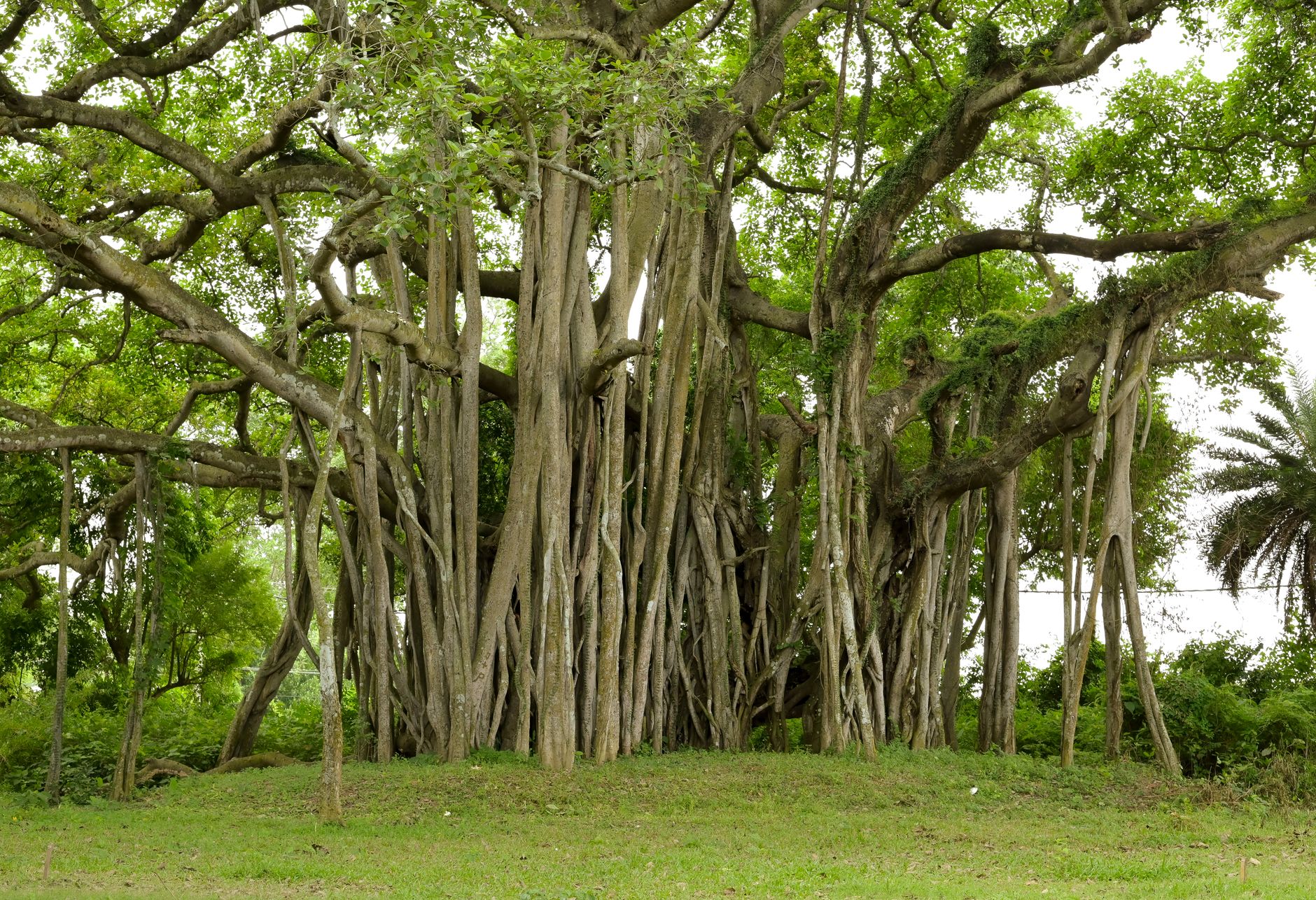
The Great Banyan is the garden's central attraction and the reason many people cross the river. Its original trunk was removed in 1925 after disease, and the tree has continued as a spreading canopy supported by aerial roots that have thickened into trunk-like columns. What remains is not a single stem but a grove that reads as one organism, with shaded paths and open ground beneath it. Fence barriers keep visitors off the root zone. Photographs work best in the early morning, before the light hardens.
Because the banyan spreads rather than rises, it does not look like the postcard image of a giant tree. Walk the full circuit to see how far the aerial roots reach; the scale is easier to judge from the lawns, where the whole canopy fits into one view. The tree is a documented botanical specimen as well as a visitor sight, and parts of the root system are protected. Keep to the paths and do not step among the roots.
How to reach Shibpur Botanic Garden
The garden is in Howrah district, so any visit involves crossing the Hooghly. The simplest route by road is over Vidyasagar Setu, the cable-stayed bridge opened in 1992, which lands close to Shibpur on the west bank. From central Kolkata the drive is short outside peak hours. Taxis and app cabs are the usual choice, and metered yellow taxis make the crossing. Traffic on the approach roads is heavy in the morning and evening peaks, so allow extra time.
A second approach combines a Hooghly ferry with a short road hop on the west bank. Ferries cross between Howrah and jetties such as Babughat, Shobhabazar and Bagbazar, and the river trip gives a different view of the bridges and the ghats. Metro Railway Kolkata's Green Line reaches Howrah Maidan under the river, which shortens the road leg. Ferry timetables and landing points change, so check current services before relying on this route.
- By road: Cross Vidyasagar Setu and continue to Shibpur; this is the fastest option outside peak traffic.
- By ferry: Take a Hooghly ferry to the Howrah bank and continue by road; check current services and landing points.
- By metro and road: Ride the Green Line to Howrah Maidan, then take a short cab or auto-rickshaw ride to the garden.
What else to see in the garden
Beyond the banyan, the garden holds a palm house, several lakes and long avenues of mature trees, with collections labelled for botanical study. The riverside edge is the most pleasant part of a cool morning, with views across the water to the city skyline. Shade varies along the route and benches are unevenly spread, so the order of a walk matters on a hot day. Expect a working garden rather than polished landscaping.
Birdlife is a draw through the year, and the lakes hold water birds in winter. Early morning gives the best light and the least noise. Nothing is arranged as an exhibition, so the pleasure comes from walking slowly, reading the labels and stopping under the taller trees. Allow two to three hours for a full circuit that includes the banyan and the water. Wear shoes that cope with grass and gravel, since the paths are not all paved.
- The Great Banyan: The garden's main sight, a spreading canopy of aerial roots that replaced the diseased original trunk.
- Palm house: A glasshouse holding palms and tropical plants, useful shelter when the weather turns.
- The lakes: Still water that draws birds, with the best viewing in the cooler months.
- Riverside edge: Open views across the Hooghly towards Kolkata, best in soft morning light.
When is the best time to visit
November to February is the comfortable window, with cool mornings, dry days and a garden that is easy to walk. December and January are the coolest months, and a jacket helps before the sun is up. March warms quickly, while April and May are hot and humid with occasional evening storms. The monsoon, roughly June to September, brings heavy rain and waterlogging. Check the India Meteorological Department forecast before a long river crossing.
Two seasonal points apply to a garden in particular. The trees are at their densest just after the monsoon, in October, as the rains end and the ground dries. Winter brings migrant birds to the water, which suits anyone carrying binoculars. Durga Puja, usually in late September or October, alters traffic across the city and the bridges, so plan around it and check the current year's dates. Weekday mornings are quieter than Sundays through most of the year.
Is the garden open every day
The garden closes on Mondays, and public holidays can affect access, so confirm before crossing the river. Opening hours and entry arrangements are set by the Botanical Survey of India and can change; check current details directly rather than relying on older listings. Entry is ticketed, with concessions that the garden office can explain. Carry cash, since card readers are not guaranteed at a garden gate.
Three practical points shape a visit. Food and drink inside the garden are limited, so carry water, particularly in the hot months. Shelter from sun and rain is scarce on the open lawns, and the riverside is exposed. The garden is a scientific institution: stay on the paths, keep off the banyan's roots, and take litter away with you. Personal photography is normally allowed, while commercial shoots and drone flights need prior permission from the garden office.
How old is the Botanic Garden
The garden was founded in 1787 by the East India Company, with Colonel Robert Kyd credited as its moving force. Its purpose was economic botany: testing plants of commercial value, including timber trees and spices, while the Company expanded its trade across Asia. The collection later shifted towards taxonomy, conservation and public education, and the garden became a scientific institution rather than a trial ground for plantation crops. That history explains the mix of ornament and experiment in the planting.
The garden now carries the name of Acharya Jagadish Chandra Bose, the Bengali scientist known for his work on plant physiology, and it sits within the network of the Botanical Survey of India. The layout has changed many times over more than two centuries, with the river frontage and the tree collection as the constants. Labels and planting beds give a sense of that depth, and a slow walk reads almost like a chronology.
Pairing Shibpur with Howrah sights
The garden sits in Howrah, so it pairs naturally with the west bank rather than with a Park Street itinerary. Howrah Bridge and the flower market at Mallick Ghat are a short road journey away and are best early in the morning, which also suits the garden. Belur Math, the headquarters of the Ramakrishna Math and Mission founded by Swami Vivekananda, lies further north along the same bank. Both stops reward an early start, before the heat and the traffic build.
Allow a half day for the garden itself, including the crossing. A full day covers the garden, the bridge and one riverside stop. Distances on this side of the river are short but traffic moves slowly, so two stops are realistic and three need an early start. Dakshineswar and Belur Math together are better given a separate morning, since both sit further upstream. Check ferry and road conditions on the day, and keep the return crossing outside the evening peak.
- Mallick Ghat: The flower market beneath the Kolkata end of Howrah Bridge, busiest and best in the early morning.
- Howrah Bridge: The cantilever bridge opened in 1943, crossed on foot or by road, with river views from the footpaths.
- Belur Math: The Ramakrishna Math headquarters on the west bank, a quiet stop further upstream.
- Dakshineswar: The Kali temple completed in 1855, on the east bank north of the city centre.
Hotels in Howrah
For Botanic Garden, Shibpur, the nearest hotel area is Howrah, with 20 stays in the IMPT hotel database. Listed 5-star first, then 4-star, then by guest score; live prices open in the IMPT app.
3★ 3★
 3★
 3★
 3★
 3★
FAQ
Is the Great Banyan inside the Botanic Garden at Shibpur?
Yes. The Great Banyan stands within the Acharya Jagadish Chandra Bose Indian Botanic Garden at Shibpur and is the garden's main attraction. Its original trunk was removed in 1925 after disease, and the tree survives as a spreading canopy held up by aerial roots. Barriers keep visitors off the root zone, and the best general view is from the nearby lawns.
Who founded the Botanic Garden at Shibpur and when?
The garden was founded in 1787 by the East India Company, with Colonel Robert Kyd credited as its moving force. It began as a centre for economic botany, testing plants with commercial potential, and later moved towards taxonomy, conservation and public education. It now carries the name of Acharya Jagadish Chandra Bose and is administered under the Botanical Survey of India.
Which day is the Botanic Garden at Shibpur closed?
The garden closes on Mondays. Public holidays can also affect access, and opening hours are set by the Botanical Survey of India rather than by the city, so confirm before crossing the river. Check the current position directly with the garden or the Botanical Survey of India, since arrangements for entry and hours can change.
How do you reach the Botanic Garden at Shibpur from central Kolkata?
The quickest route is by road over Vidyasagar Setu, which lands close to Shibpur on the west bank. A ferry across the Hooghly to Howrah followed by a short road hop is slower but more scenic. Metro Railway Kolkata's Green Line reaches Howrah Maidan, cutting the road leg. Check current metro and ferry services before setting out.
How long does a visit to the Botanic Garden at Shibpur take?
Allow two to three hours inside for a full circuit that takes in the Great Banyan, the palm house, the lakes and the riverside edge. With the crossing from central Kolkata added, a half day is realistic. Anyone interested in birds or botanical labels should allow longer, and photographers tend to stay for the morning light.
Is the Botanic Garden at Shibpur suitable for children?
The garden is flat and open, with space to run and plenty of birds and trees to look at, so it suits families. There is no playground or visitor centre aimed at children. Water at the lakes and the exposed riverside need supervision, and the heat from March onwards makes an early start sensible. Carry water and snacks.
Can you buy food inside the Botanic Garden at Shibpur?
Food and drink inside the garden are limited, so carry water and something to eat, especially in the hot months. Shade and seating are unevenly spread across the lawns. For a proper meal, head back across the river to central Kolkata, or eat near Howrah station before or after the visit.
When is the best time of year for the Botanic Garden at Shibpur?
November to February is the most comfortable stretch, with cool mornings, dry days and easy walking. December and January are the coolest. October, as the monsoon ends, is when the trees are densest. April and May are hot and humid. The monsoon, roughly June to September, brings heavy rain and waterlogging. Check the India Meteorological Department forecast.
Is photography allowed at the Botanic Garden at Shibpur?
Personal photography is normally allowed, and the Great Banyan and the riverside are the obvious subjects. Commercial shoots and drone flights usually need prior permission from the garden office, since the site is a scientific collection under the Botanical Survey of India. Rules can change, so ask at the gate before setting up equipment.
Read next
Sources: Botanical Survey of India, West Bengal Tourism, Metro Railway Kolkata, India Meteorological Department.
Editorial review: 3 November 2026. Opening days, fares and festival dates change; check before you go.