 4★
Kumartuli is the potters' quarter of North Kolkata, beside the Hooghly near Bagbazar and Sovabazar. Workshops here build Durga idols from straw, bamboo and river clay between July and September, and make Kali, Lakshmi and Saraswati figures through the rest of the year. A walk through the lanes takes one to two hours. Ask before photographing or entering a studio.
What is Kumartuli?
Kumartuli is the potters' quarter of North Kolkata, a dense grid of workshops and narrow lanes beside the Hooghly where idols of Durga, Kali, Lakshmi and Saraswati are shaped from straw, bamboo and river clay. The name joins kumar, meaning potter, with tuli, a settlement or quarter. Families here have worked in clay for generations, and most studios double as workshops, storerooms and homes through the year. Orders come from pandal committees, temples and households across the city.
The quarter is a working neighbourhood rather than a museum, so a visit means walking past open doorways where sculptors are mid-task. Expect clay underfoot, racks of drying heads and hands, and stacks of bamboo frames leaning against walls. A slow walk through the main lanes takes about an hour, and two hours if photography and conversation with artisans are part of the plan. North Kolkata is the natural base for an early start.
Where is Kumartuli in Kolkata?
Kumartuli lies in North Kolkata, on the east bank of the Hooghly, between Bagbazar and Sovabazar. The nearest metro station is Sovabazar Sutanuti on the Blue Line, a short walk away through the old streets. Bagbazar ghat and Kumartuli ghat sit at the river edge of the quarter. The lanes are narrow, signage is limited, and the boundaries between one workshop and the next are not always obvious to a first-time visitor.
Rabindra Sarani is the main road to aim for, and most walking routes enter the quarter from it. Jorasanko Thakurbari, Marble Palace and the College Street book market are all within a few kilometres, which makes a North Kolkata morning easy to plan. Traffic in the lanes becomes heavy in the weeks before Durga Puja, when vehicles arrive to collect finished idols. Check with West Bengal Tourism for any local access changes.
How are the Durga idols made?
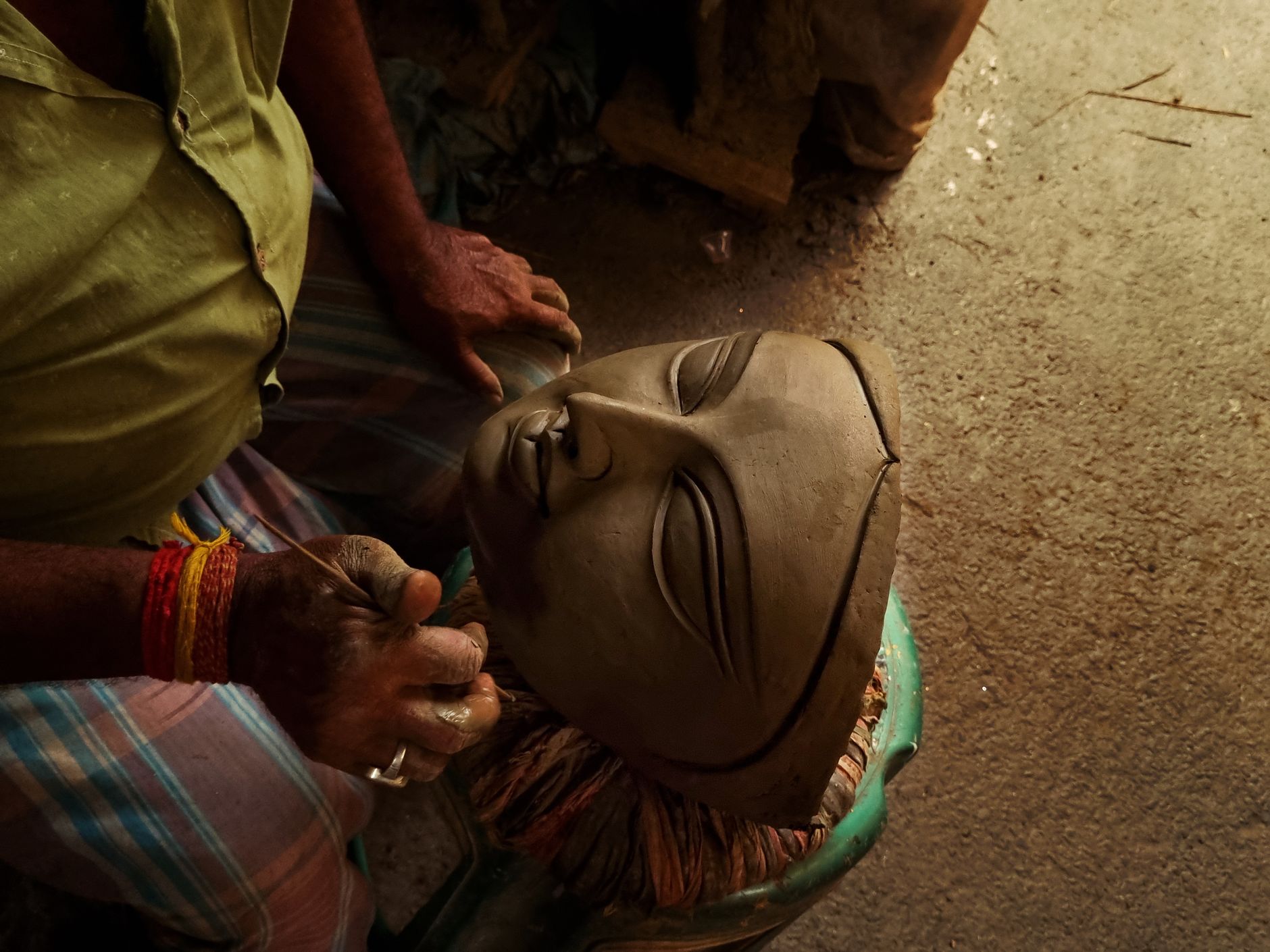
Work begins with a frame of split bamboo and straw, tied into the pose the finished figure will hold and fixed to a wooden base. Clay dug from the river banks near the ghats is mixed with rice husk and other binders, then pressed over the frame in layers and left to dry. Faces and hands are usually moulded separately and attached later. Idols are built to the scale the commissioning pandal has asked for, from small household pieces to figures several metres high.
Once the clay has dried, surfaces are smoothed and given a thin coat of clay slip before painting. Painters take over for the features, and the eyes are added last, in a step that carries ritual weight for the workshop. Ornaments, crowns and clay jewellery are made in the same lanes, often by other families. A large idol can take weeks from frame to finish, with several pairs of hands involved at different stages.
The craft does not stop after Durga Puja. Studios move on to Kali figures for the new-moon night of Diwali, then to Lakshmi and Saraswati orders for the winter and spring festivals, plus small figures for household shrines. Some workshops accept commissions for set pieces and display work. Outside the peak months the lanes are quieter, and artisans are more likely to have time to explain how a figure is built.
- Bamboo frame: A skeleton of split bamboo and straw is tied into shape and fixed to a wooden base.
- River clay: Clay from the Hooghly banks is mixed with binders and pressed over the frame in layers.
- Face and hands: Heads and palms are moulded separately, dried, then fixed to the figure.
- Priming: Dried idols are smoothed and given a thin clay slip and a base coat.
- Eyes and finish: Painters add the features, with the eyes last, then attach crowns and jewellery.
When is the best time to visit Kumartuli?
The quarter is busiest from July to September, in the run-up to Durga Puja, when the clay is still wet and the lanes are full of half-finished figures. This is the most rewarding window for anyone who wants to see the work in progress. Durga Puja falls in late September or October, so check the current year's dates before planning a trip around it. After the festival the workshops turn to other deities.
From November to February the weather is comfortable and the lanes are calm, though fewer large idols stand on the floor. Kali Puja work peaks in October or November, and Saraswati and Lakshmi orders keep studios busy in winter and early spring. Mornings are cooler and better for photography. Avoid the hottest afternoons in April and May, and expect waterlogging in the monsoon months of June to September.
What happens in the weeks before Durga Puja?
Mahalaya, about a week before Durga Puja, marks the ritual start of the festival, and by then most idols have left the studios for pandals across the city. The final weeks are a race: painters finish faces, decorators fix crowns, and vehicles wait in the lanes for loading. Figures leave by road, and some are taken to the ghats for onward transport. Visitors in this period see the trade at full speed but should stay clear of lifting and loading.
After the festival, attention turns to other figures. Kali Puja, on the new-moon night of Diwali, needs its own idols, and the studios move straight into that work. Lakshmi Puja follows Durga Puja within days, and Saraswati Puja comes in January or February. Smaller orders for household shrines and shop displays run through the year, which keeps most workshops occupied even when the lanes look quiet.
- Durga: The largest commissions, built from July to September for pandals across the city.
- Kali: Made for Kali Puja on the new-moon night of Diwali, in October or November.
- Lakshmi: Smaller figures prepared for Lakshmi Puja, which follows Durga Puja within days.
- Saraswati: A winter order for Saraswati Puja, which falls in January or February.
How do you get to Kumartuli?
Sovabazar Sutanuti on the Blue Line is the closest metro station, and the walk from there to the workshops passes through the oldest streets of the district. Buses run along Rabindra Sarani. Yellow taxis and app cabs can drop at the edge of the quarter, where the lanes narrow and through traffic becomes difficult. From Park Street or Esplanade the metro ride is straightforward; check Metro Railway Kolkata for current hours and any line changes.
Ferries on the Hooghly stop at Bagbazar and at the ghats beside Kumartuli, which puts you at the river edge of the district. Coming from Howrah or from the south of the city, allow time for congestion on Rabindra Sarani, which is heavy for much of the day. The lanes themselves are best covered on foot, and a loop from Sovabazar via Bagbazar back to Rabindra Sarani takes in the main studios.
What are the visiting rules in Kumartuli?
Kumartuli is a residential and working area, not a visitor attraction with set opening hours. Studios are family workplaces, so ask before stepping inside or photographing anyone. Some workshops ask for a contribution towards photography, and it is fair to agree this before taking pictures. Keep to the lanes, do not touch wet clay or move drying pieces, and avoid blocking doorways where finished idols are being carried out to vehicles.
Dress modestly, keep voices low, and do not enter a space where a family is working unless invited. Children are often about, and the surface underfoot is uneven and sometimes slippery. If you want to buy a small figure, ask the artisan directly rather than a middleman. Studio hours follow the workload rather than a timetable, so mornings and early evenings are the likeliest times to find work in progress.
- Ask first: Request permission before entering a studio or photographing a sculptor at work.
- Expect a fee: Some studios ask for a contribution for photography; agree it before shooting.
- Watch your step: Clay, water and drying racks make the lanes uneven and slippery.
- Do not touch: Unfired clay and painted surfaces mark easily and cannot be repaired.
- Buy directly: Small finished figures can often be bought from the studio that made them.
What else is near Kumartuli?
The quarter sits in a part of North Kolkata with several sights within easy reach. Jorasanko Thakurbari, the Tagore family home and now a museum, is a short ride away, and Marble Palace on Muktaram Babu Street needs a permit arranged in advance. The College Street book market and the Indian Coffee House on Albert Hall are further south but simple to combine with a morning in the potters' lanes.
Down at the river, Bagbazar ghat and its neighbours are part of the daily life of the district, with boats, bathing steps and small shops. A longer walk south reaches Sovabazar and the old lanes towards Shyambazar. For a full day, pair Kumartuli with a North Kolkata walk in the morning and the Maidan or Park Street in the afternoon, when the light softens over the open ground.
- Jorasanko Thakurbari: Tagore's birthplace and family home, now the Rabindra Bharati Museum.
- Marble Palace: An 1835 private residence in North Kolkata; entry needs a free permit, so check arrangements.
- Bagbazar ghat: A working river ghat at the western edge of the quarter, served by ferries.
- College Street: The book market and coffee houses, a short ride south of the workshops.
Hotels in North Kolkata
For Kumartuli, the nearest hotel area is North Kolkata, with 13 stays in the IMPT hotel database. Listed 5-star first, then 4-star, then by guest score; live prices open in the IMPT app.
4★ 3★
OYO Flagship 19290 Bag Bazaar
North Kolkata, Kolkata · 3-starGuest score 3.9/5 · 281 reviewsSee live price 3★
Goroomgo Elite Inn Ultadanga Kolkata
North Kolkata, Kolkata · 3-starGuest score 2.2/5 · 6 reviewsSee live price 3★
 3★
 3★
FAQ
Is Kumartuli worth visiting?
Yes, for anyone interested in how Kolkata's festivals are made. Kumartuli is a working quarter where idols take shape from bamboo, straw and river clay, and a walk through the lanes shows the craft at close range. It suits travellers already heading to North Kolkata for Jorasanko Thakurbari, Bagbazar or the river ghats, and needs about an hour.
What is the best time to see idols being made in Kumartuli?
July to September is the peak, when Durga idols are built for pandals across the city and the lanes are at full speed. Kali figures follow in October or November, and Saraswati orders arrive in winter. Durga Puja dates move each year, so check the current year's festival calendar before booking travel.
Can you take photographs in Kumartuli?
Ask before photographing artisans at work, and ask again before entering a studio. Some workshops request a contribution for photography, so agree the arrangement first. Do not move drying pieces or stand in doorways where idols are being carried. Early morning light is softer, and the lanes are quieter before the day's deliveries begin.
How long does a visit to Kumartuli take?
Most visitors spend one to two hours walking the lanes, looking into studios and talking to artisans. A short loop from Sovabazar Sutanuti metro station towards Bagbazar covers the main workshops. Add time if you plan to photograph in detail, or if you continue to Jorasanko Thakurbari or Marble Palace, which turns the outing into a half day.
Which metro station is closest to Kumartuli?
Sovabazar Sutanuti on the Blue Line is the nearest station, and the walk from there passes through the old lanes towards the river. The Blue Line runs from Dakshineswar to Kavi Subhash via Shyambazar, Esplanade and Park Street. Check Metro Railway Kolkata for current hours and any service changes before setting out.
Are there idols to see in Kumartuli outside Durga Puja?
Yes. After Durga Puja the studios turn to Kali figures for the new-moon night of Diwali, then to Lakshmi, Saraswati and smaller household pieces. Late autumn and winter are cooler and quieter, with fewer large commissions on the floor. Visitors see fewer finished idols but get more chance to talk with the artisans about the work.
Is Kumartuli safe to walk around?
The lanes are narrow, uneven and often wet with clay and water, so watch your footing and keep bags close in crowded stretches. The quarter is residential and generally calm outside the pre-festival weeks. Visit in daylight, stay clear of vehicles being loaded, and keep to public lanes rather than entering private workspaces uninvited.
Can you buy an idol in Kumartuli?
Small finished figures can sometimes be bought directly from the studio that made them, and artisans will explain what can travel safely. Large Durga idols are built to order for pandals and are not made for shipping. Ask about packing and transport before agreeing to anything, and check customs rules if the figure is leaving India.
How do you combine Kumartuli with other North Kolkata sights?
Pair the quarter with Jorasanko Thakurbari, Marble Palace and the ghats at Bagbazar, all within a short ride. Start in the morning, when studios are active and the lanes are cooler. A North Kolkata walk can then finish at College Street, or continue south to the Maidan for the afternoon.
Read next
Sources: West Bengal Tourism, Kolkata Municipal Corporation, Metro Railway Kolkata, Indian Railways (IRCTC).
Editorial review: 3 November 2026. Opening days, fares and festival dates change; check before you go.